
Engine management system - siemens (all except NAS) (Vacuum Actuator): Description and operation
- Make
- Land Rover
- Model
- Freelander System Description and Operation (UK)
- Section
- Description and operation › Vacuum Actuator
Vacuum Actuator
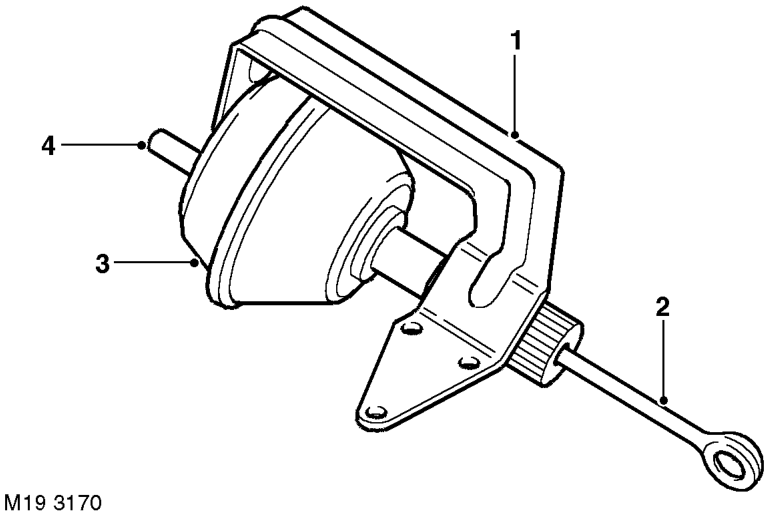
1 Mounting bracket 2 Actuating rod
3 Diaphragm chamber 4 Vacuum pipe connection
The vacuum actuator translates pneumatic pressure changes into axial movement to operate the throttle. The actuator is installed in a mounting bracket attached to the throttle body.
A diaphragm installed in a chamber is connected to the vacuum pump assembly on one side and vented to atmosphere on the other. An actuating rod connects the diaphragm to the throttle linkage on the throttle body. When cruise control is engaged, the vacuum pump assembly reduces the pressure on one side of the diaphragm and the diaphragm moves the actuating rod to operate the throttle. The operating range of the vacuum actuator is from 0 to 88 ± 4 % of throttle opening. This ensures there is sufficient range to induce normal down gear changes, but prevents kickdown.
The throttle linkage allows the vacuum actuator to operate the throttle without moving the accelerator pedal, and also allows the accelerator pedal to override the vacuum actuator, to increase throttle opening, when the driver wants to accelerate the vehicle above the set speed.
Brake Pedal Position Sensor
Outputs from the brake pedal position sensor are supplied to the interface ECU and the cruise control ECU to enable the system to detect when the brakes are applied. The brake pedal position sensor is a Hall effect sensor that produces two outputs. One output is supplied to both the interface ECU and the cruise control ECU; the second output is only supplied to the interface ECU. Both outputs should be 0 to 2 volts while the brake pedal is released, then increase to between 8 and battery volts when the brake pedal is pressed.
Brake Pedal Switch
An output from the brake pedal switch is supplied to the vacuum pump assembly to ensure cruise control disengages when the brakes are applied, even if the vacuum pump assembly remains active. The dump valve in the vacuum pump assembly is earthed via the brake lamps and energised closed while cruise control is active. The brake pedal switch is open while the brake pedal is released. When the brakes are applied, the brake pedal switch closes and connects a power feed to the brake lamps circuit, and thus to the earth side of the dump valve. This ensures the dump valve is de-energised, which allows it to open and release the vacuum from the vacuum actuator.
Parts & tools for this job For Land Rover Freelander
- PARTEngine gasket setSearch: Land Rover Freelander engine gasket set
- TOOLTorque wrenchSearch: 3/8 inch torque wrench
- TOOLFeeler gauge setSearch: feeler gauge set
Links open Amazon search results in a new tab. As an Amazon Associate I earn from qualifying purchases.