ABS Indicator Light
- Make
- Rover
- Model
- 600 Rover 600 Repair Manual - Volumes 1 and 2 - 2nd Edition
- Section
- Operation › ABS Indicator Light
ABS Indicator Light
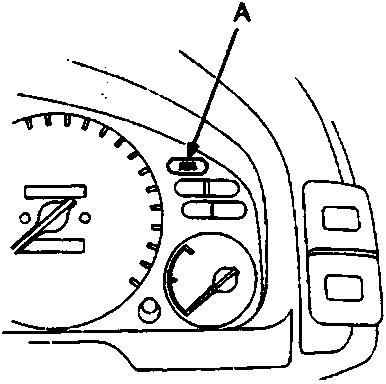
A ABS indicator light
70M 0115
The ABS indicator light comes on for 3 seconds and then goes off when the control unit detects no problems during the initial diagnoses after the engine is started.
However, the ABS indicator light can stay on for up to 40 seconds when the engine control unit starts to check for pump overrun, during the initial diagnosis.
The ABS indicator comes on, and the ABS control unit memorizes the diagnostic trouble code (DTC) under the following conditions.
- When the parking brake is applied for more than 30 seconds while the vehicle is being driven. DTC: 2-1
- The transmission has downshifted excessively. DTC: 4-1, 4-2
- The vehicle loses traction, with wheel spin for more than a minute, when attempting to move from rest on a muddy, snowy, or sandy road. DTC: 4-8
- The tyre(s) adhesion is lost due to excessive cornering speed. DTC: 5, 5-4, 5-8
- The vehicle is driven on an extremely rough road. DTC: 8-1
- The vehicle is affected by strong (illegal) radio waves (noise) DTC: 8-2
Note: If there is a problem in the system whilst driving, the ABS indicator light will come on.
Diagnostic Trouble Code – DTC
- When the control unit detects a problem and the ABS indicator comes on, the ABS control unit memorizes the DTC.
- The control unit has 3 memory registers. When a problem occurs, the control unit stores the DTC in the first register. Should another problem occur, or the same problem occurs again, the register movers the first DTC up to the next memory, and stores the second DTC in the first register. If a third fault occurs, the 2 previous DTC's move up one register, and the third DTC is stored in the first register. If problems continue to occur, the problem in the third register is lost each time.
- The most recent DTC is indicated first, and the the oldest DTC is the third.
- The DTC's are erased from the control unit when the ABS + B2 power supply is disconnected.
- The control unit's memory can be erased by disconnecting the ABS B2 fuse for more than 3 seconds.
Note: If you receive a customer's report that the ABS indicator light sometimes comes on, check the fault code in the ECU memory first and use Microcheck. Do not use Microcheck before checking the fault code since this disconnects the ECU from the battery and any fault codes stored will be lost.
Self-diagnosis
- There are 3 self-diagnosis systems:
- Initial diagnosis: Performed immediately after the engine is started until the ABS indicator light goes out.
- Regular diagnosis: Continuously performed (certain conditions) after the ABS indicator light goes out and until the engine is switched off.
- Individual part/system diagnosis: Diagnosis about a specific part/system under its operating conditions.
- The CPU (central processing unit) controls the following when it detects a problem under self-diagnosis:
- Turns the ABS indicator light ON.
- Turns the front and rear fail-safe relays off.
- Stops the ABS control.
- Stops the ABS pump (the pump may work under some conditions)
Parts & tools for this job For Rover 600
- TOOLOBD2 scanner with ABSSearch: OBD2 scanner ABS SRS
- TOOLDigital multimeterSearch: automotive digital multimeter
Links open Amazon search results in a new tab. As an Amazon Associate I earn from qualifying purchases.