
Ignition operating diagram (page 2 of 2)
- Make
- Fiat
- Model
- Bravo /Brava (182) Factory Service Manual
- Year
- 1995–2001
- Section
- Fuel system (1581 16v)
When the voltage required for triggering an arc between the spark plug electrodes is examined, we note that voltage is high in the cylinder undergoing compression (about 10kV) while it is reduced (about 5kV) in the cylinder undergoing exhaust.
High tension distribution is static, i.e. takes place without a rotary brush and cap. This system effectively does away with a distributor. This gives the system a considerable advantage because it is known that brush and cap insulation properties play an important role. Any loss of insulation to earth may impair ignition: particularly during winter or periods of heavy rain.
The spark plugs of cylinders 1-4 and 2-3 are connected directly (in pairs) by means of high tension leads to coil secondary winding terminals and may be considered to be connected in series, because the cylinder head joins them all. This solution is also known as a "lost spark" system because the energy built up by the coil discharges almost exclusively on the electrodes of the spark plug located in the cylinder under compression to allow mixture ignition. The other spark is obviously unused because the cylinder does not contain mixture for ignition - solely exhaust gas ready for venting.
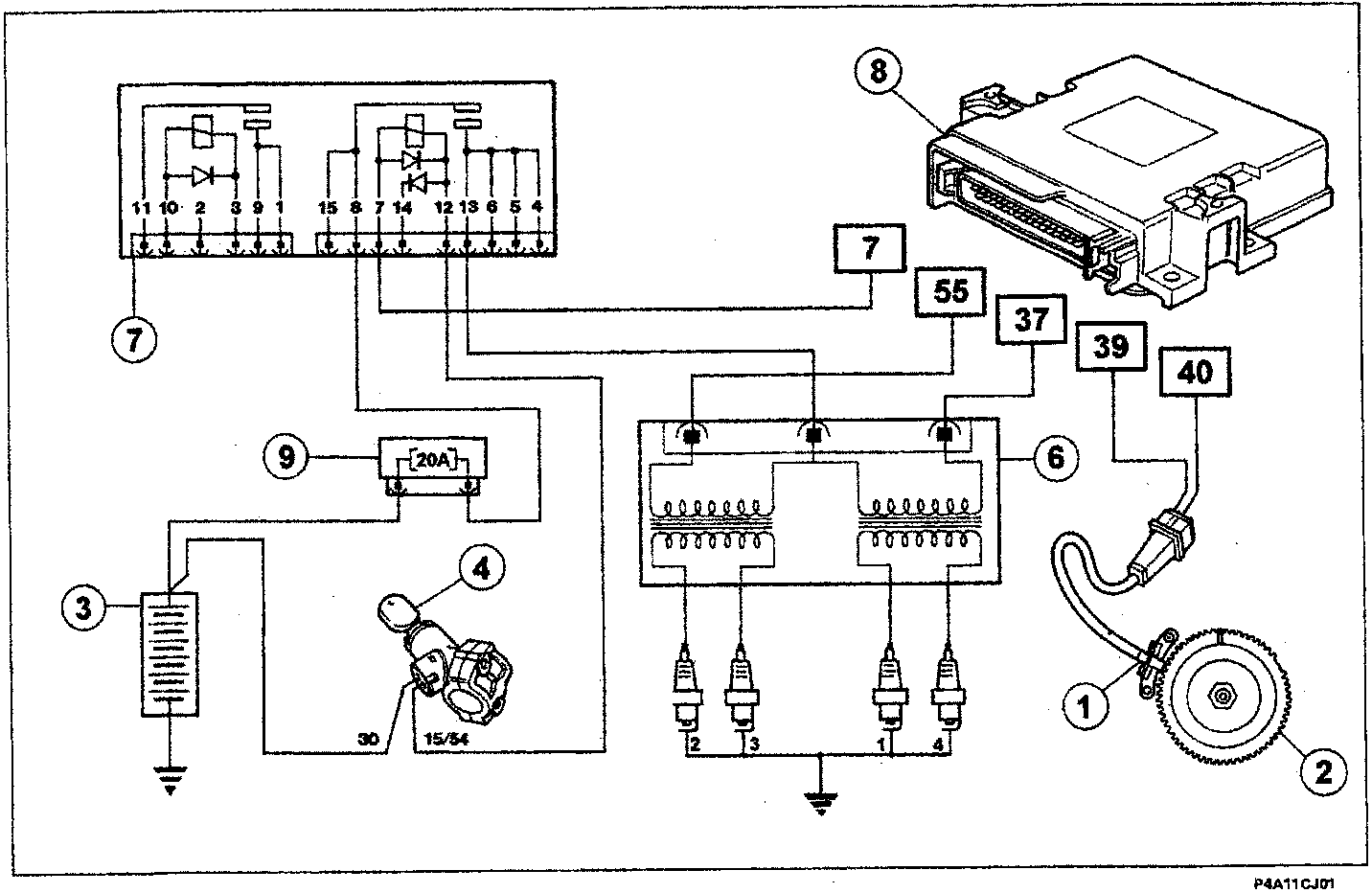
- Rpm and TDC sensor
- Crankshaft pulley with phonic wheel
- Battery
- Ignition switch
- Spark plugs
- Ignition coils
- Dual relay
- Injection-ignition ECU
- Injection-ignition system fuse
Parts & tools for this job For 1995 Fiat Bravo
- PARTFuel filterSearch: Fiat Bravo 1995 fuel filter
- TOOLFuel pressure test kitSearch: fuel pressure test kit
- TOOLFuel line disconnect toolSearch: fuel line disconnect tool
Links open Amazon search results in a new tab. As an Amazon Associate I earn from qualifying purchases.