
Protection against excess rpm (page 2 of 2)
- Make
- Fiat
- Model
- Bravo /Brava (182) Factory Service Manual
- Year
- 1995–2001
- Section
- Fuel system (1581 16v)
The ignition circuit is static inductive discharge type, i.e. a high tension distributor with power modules located inside the injection-ignition control unit.
The system comprises two high tension twin outlet coils combined in a single container and connected directly to the spark plugs.
The primary winding of each coil is connected to the power relay (i.e. supplied by battery voltage) and pins of the ECU for connection to earth.
Once the start-up stage is over, the I.A.W. - 1AF -13 ECU implements a base pulse constant taken from a specific map in accordance with the following input parameters:
- engine rotating speed (rpm),
- absolute pressure reading (mmhg) obtained in intake manifold.
This advance setting is corrected according to temperature.
The advance angle is also subject to correction under the following conditions:
- during start-up;
- during transitory stages of acceleration and over-run.
- during cut-off.
- when rpm is excessive.
For the ignition system to work efficiently, the ECU must recognise signal configuration (3).
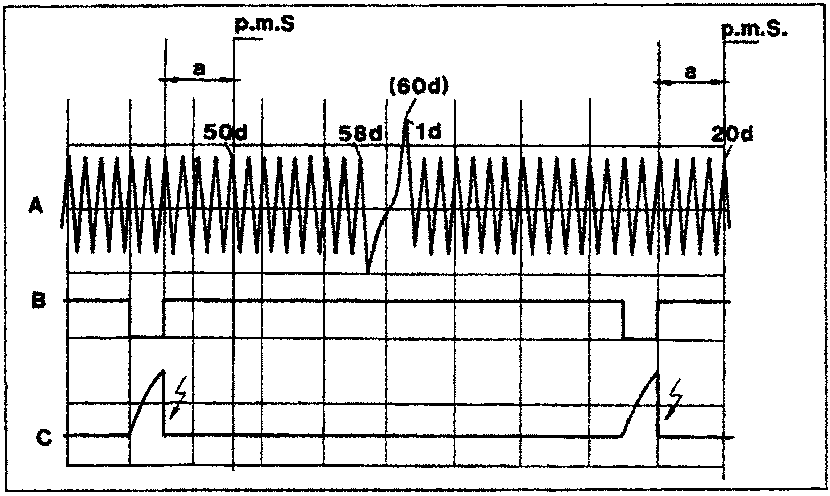
- A. Rpm sensor signal
- B. Power control
- C. Current running through coil primary winding
- a. Ignition advance with reference to cylinder TDC
The gap or change in signal generated by the lack of two teeth on the phonic wheel, more specifically between the 58th and 1st tooth (known also as the synchronism tooth) which occurs each time the crankshaft pulley turns is a reference signal which allows the ECU recognition 114° in advance of TDC of piston pair 1-4 in correspondence to falling front of 20th tooth.
Once the ECU (see following page) has received the correct T.D.C. signal configuration, it establishes the point at which conduction (supply) to primary circuits of coils (6) begins and makes internal power module (5) conductive.
Parts & tools for this job For 1995 Fiat Bravo
- PARTFuel filterSearch: Fiat Bravo 1995 fuel filter
- TOOLFuel pressure test kitSearch: fuel pressure test kit
- TOOLFuel line disconnect toolSearch: fuel line disconnect tool
Links open Amazon search results in a new tab. As an Amazon Associate I earn from qualifying purchases.