Disc Runout Inspection
- Make
- Rover
- Model
- 600 Rover 600 Repair Manual - Volumes 1 and 2 - 2nd Edition
- Section
- Brakes: repairs › Disc Runout Inspection
Brakes and ABSDisc Runout Inspection
Disc Runout Inspection
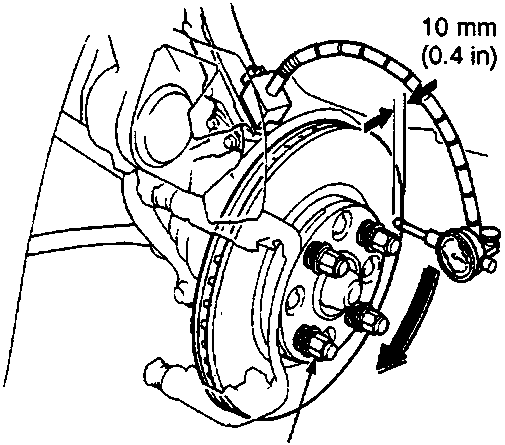
A Wheel nuts and plain washer
- Raise front of vehicle.
- WARNING: Support on safety stands.
- Remove road wheel(s).
- Remove the brake pads.
- Inspect the disc surface for damage or cracks. Clean the disc thoroughly and remove all rust.
- Use the wheel nuts and suitable plain washers to hold the disc securely against the hub, then mount a dial indicator as shown and measure the runout at 10mm (0.4 in) from the outside edge of the disc.
Brake Disc Runout = 0.10mm (0.004 in)
- If the disc is beyond the service limit, refinish with an on - car brake lathe as recommended in the Service Tools and Equipment Programme.
Max. Refinishing Limit = 21.0mm (0.83 in)
Note: A new disc should be refinished if its runout is greater than 0.10mm (0.004 in).
Disc Thickness and Parallelism Inspection
- Raise front of vehicle.
- WARNING: Support on safety stands.
- Remove road wheel(s).
- Remove the brake pads.
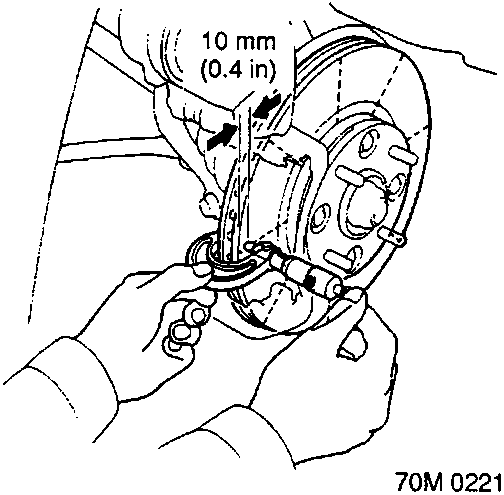
- Using a micrometer, measure disc thickness at eight points, approximately 45° apart and 10mm (0.4 in) in from the outer edge of the disc.
Brake Disc Thickness = 23.0mm (0.91 in)
Max. Refinishing Limit = 21.0mm (0.83 in)
Note: Replace the brake disc if the smallest measurement is less than the max. refinishing limit.
Brake Disc Parallelism = 0.015mm (0.0006 in) max.
Note: The maximum difference between any thickness measurements should not be more than specification.
- If the disc is beyond the service limit, refinish with an on - car brake lathe as recommended in the Service Tools and Equipment Programme.
Parts & tools for this job For Rover 600
- PARTBrake padsSearch: Rover 600 brake pads
- TOOLBrake bleeder kitSearch: one man brake bleeder kit
- FLUIDBrake fluidSearch: brake fluid
Links open Amazon search results in a new tab. As an Amazon Associate I earn from qualifying purchases.