
Diagram of exhaust assembly
- Make
- Fiat
- Model
- Bravo /Brava (182) Factory Service Manual
- Year
- 1995–2001
- Section
- Fuel system (98 range, 1581 16v) › Diagram of exhaust assembly
DIAGRAM OF EXHAUST ASSEMBLY
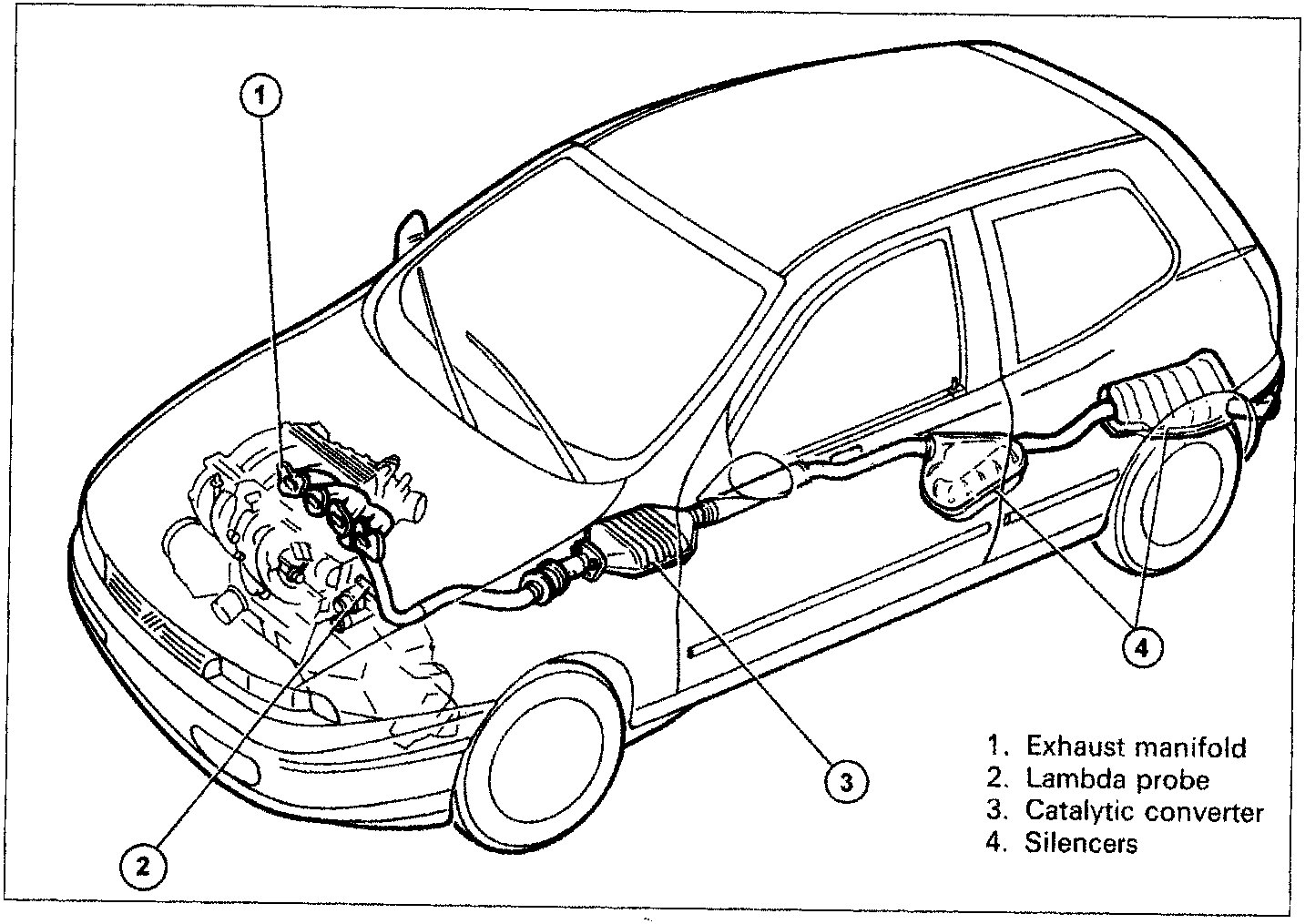
- Exhaust manifold
- Lambda probe
- Catalytic converter
- Silencers
On the I.A.W. system, the closed-loop control of the mixture strength is activated by the Lamba sensor which measures the oxygen content present in the exhaust gases upstream of the catalytic converter.
The Lamba probe's measurements enable the electronic control unit to make continuous corrections of the mixture strength, keeping the air/fuel ratio constant.
In this way, there is control of the harmful emissions in the exhaust, which is completed by the trivalent catalytic converter.
The efficient operation of the catalytic converter and consequently reduction in toxicity of the exhaust gases depends on the air/fuel ratio with which the engine is supplied.
The trivalent catalytic converter simultaneously reduces the three polluting gases present in the exhaust gases: unburnt hydrocarbons (HC), carbon monoxide (CO) and nitrogen oxides (NOx).
Two types of chemical reactions take place inside the converter:
- oxidation of the CO and HC, converted into carbon dioxide (CO2) and water (H2O)
- reduction of NOx, converted into nitrogen (N2).
The causes which quickly and irreparably put the catalytic converter out of use are:
- presence of lead in petrol, which reduces the level of conversion such that its presence in the system is futile;
- presence of unburnt petrol in the converter; a flow of petrol lasting 30 s in an environment of 800°C (silencer's internal temperature) is sufficient to cause the converter to melt and break. It is absolutely necessary for the ignition system to be working perfectly, so under no circumstances should the spark plugs be removed when the engine is running; during tests, the silencer must be replaced with an equivalent piece of pipe.
Parts & tools for this job For 1995 Fiat Bravo
- PARTExhaust gasketSearch: Fiat Bravo 1995 exhaust gasket
- TOOLPenetrating oilSearch: penetrating oil
- TOOLOBD2 scannerSearch: OBD2 scanner
Links open Amazon search results in a new tab. As an Amazon Associate I earn from qualifying purchases.