
Cavity wax application equipment and techniques
- Make
- Land Rover
- Model
- Discovery II (UK)
- Section
- Materials and applications › Cavity wax application equipment and techniques
Cavity wax application equipment and techniques
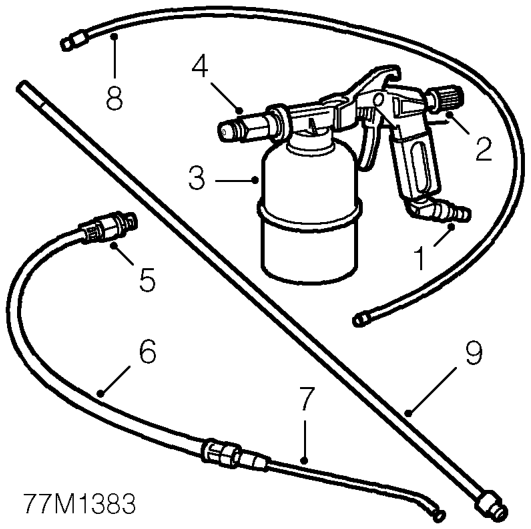
1 Air inlet 2 Flow control (spray pattern adjustment) 3 Pressure cup (1 litre capacity). Maximum pressure 140PSI (9.7 bar, 9.84 kg/cm3) 4 Gun connector 5 Lance nipple connection 6 Flexible lance 7 Rigid directional hook wand (forward cone spray pattern) 8 Flexible nylon lance 1100 mm (43.307 in) with 360° spray pattern 9 Rigid lance 1100 mm (43.307 in) with 360° spray pattern
When re-treating wax-injected areas which have been disturbed during repairs, it is necessary to use a compressed air spray gun with integral pressure cup and a selection of interchangeable lances.
The following points must be observed during use, according to the attachments fitted: l Use the rigid or flexible lance attachments with 360° spray dispersal when treating enclosed areas, to ensure maximum coverage; l Where openings are restricted, use the hook nozzle to provide a more directional spray (e.g. inside narrow or short box sections); l Spray exposed underbody surfaces directly from the gun less lance attachment and without disconnecting the fluid coupling.
1100 mm (43.307 in) rigid lance The nozzle on the rigid lance produces a 360° circular spray pattern combined with a forward-directed spray. Although wax is distributed to all box section surfaces in a single stroke, effective and complete coverage is obtained in long straight structures and box section cavities by spraying on both inward and outward strokes of the lance.
The rigid lance also provides the positional accuracy required in shaped sections, by allowing visual assessment.
CAUTION: Do not force the lance into access holes when using this attachment.
1100 mm (43.307 in) flexible nylon lance This lance is similar in pattern to the rigid version, but provides the additional penetration required for curved sections or in places where access is difficult. Its main limitation is a lack of positional accuracy inside box sections.
Carry out all spraying on the outward stroke of the lance. Withdraw the lance slowly to ensure sufficient coverage. Do not withdraw the lance too quickly.
Parts & tools for this job For Land Rover Discovery
- TOOLTrim removal tool kitSearch: trim removal tool kit
- PARTTouch-up paintSearch: Land Rover touch up paint
- PARTPanel clip assortmentSearch: Land Rover panel clips assortment
Links open Amazon search results in a new tab. As an Amazon Associate I earn from qualifying purchases.