
Brake system bleeding (Brakes)
- Make
- Land Rover
- Model
- Discovery II (UK)
- Section
- Adjustments › Brake system bleeding
Brake system bleeding
$% 70.25.02
Bleeding of the brake system can be carried out using the procedures given on TestBook, or by following the manual procedure given below.
WARNING: If any components upstream of brake modulator, including the modulator itself are replaced, the brake system must be bled using the procedure on TestBook/T4, to ensure that all air is expelled from the new component(s).
WARNING: Do not allow brake fluid to come into contact with eyes or skin.
Bleed
NOTE: This procedure covers bleeding the complete system, but where only the primary or secondary circuit have been disturbed in isolation, it should only be necessary to bleed that circuit. Partial bleeding of the hydraulic system is only permissible if a brake pipe or hose has been disconnected with only minor loss of fluid.
- Do not allow fluid level in master cylinder to fall below 'MIN' mark during bleeding.
- Do not fill reservoir above 'MAX' level.
- Raise front and rear of vehicle.
WARNING: Do not work on or under a vehicle supported only by a jack. Always support the vehicle on safety stands.
- Top-up brake fluid level to 'MAX' mark.
- Check all pipe and hose connections are tight and there are no signs of leakage.
- Top-up fluid level in brake reservoir to 'MAX' mark.
WARNING: Do not allow dirt or foreign liquids to enter the reservoir. Use only new DOT 4 brake fluid from airtight containers. Do not mix brands of brake fluid as they may not be compatible.
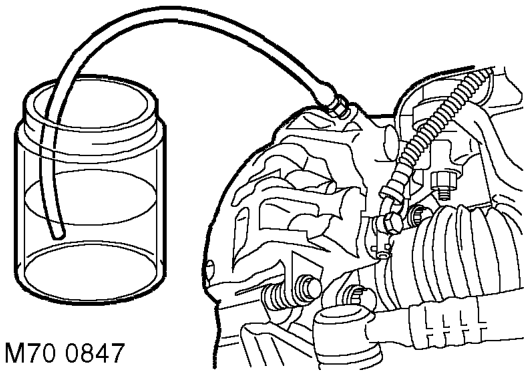
- Attach bleed tube to the bleed screw on front brake caliper on the passenger side, submerge free end in a clear container containing brake fluid.
- Apply pressure to brake pedal several times, then apply steady pressure.
- Loosen bleed screw to release brake fluid and air. Allow pedal to return unassisted.
- Depress brake pedal steadily through its full stroke and allow to return unassisted. Repeat procedure until a flow of clean air-free fluid is purged into container then, whilst holding pedal at end of downward stroke, tighten brake caliper bleed screw to 10 Nm (7 lbf.ft).
CAUTION: Ensure the fluid in the reservoir is maintained between the minimum and maximum levels throughout the bleed procedure using new brake fluid.
Parts & tools for this job For Land Rover Discovery
- PARTBrake padsSearch: Land Rover Discovery brake pads
- TOOLBrake bleeder kitSearch: one man brake bleeder kit
- FLUIDBrake fluidSearch: brake fluid
Links open Amazon search results in a new tab. As an Amazon Associate I earn from qualifying purchases.