
Viscous fan operation (Cooling system - Td5)
- Make
- Land Rover
- Model
- Discovery II (UK)
- Section
- Description and operation › Viscous fan operation
Viscous fan operation
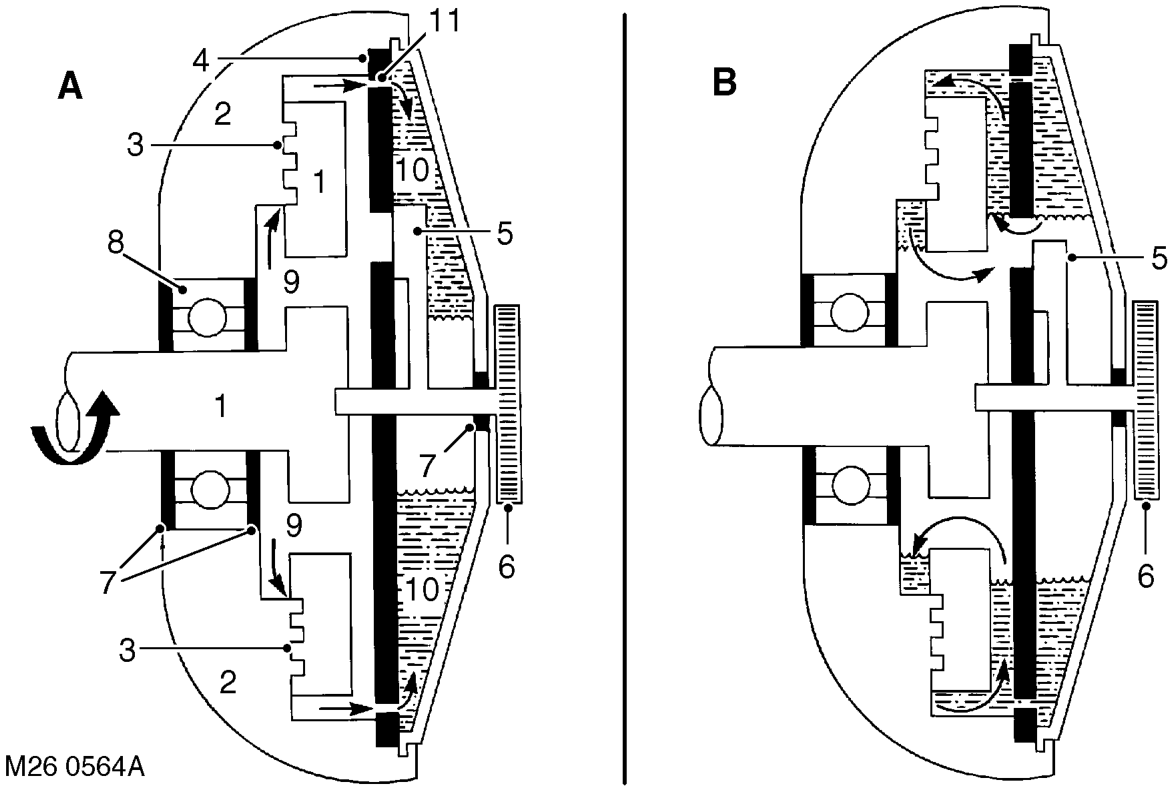
A= Cold, B= Hot
1 Drive plate 2 Fan body 3 Clearance 4 Valve plate 5 Valve 6 Bi-metallic coil
7 Fluid seals 8 Ball race 9 Fluid chamber 10 Reservoir 11 Return port
When the engine is off and the fan is not rotating, the silicone fluid stabilises within the fluid chamber and the reservoir. The fluid levels equalise due to the return port in the valve plate being open between the fluid chamber and the reservoir. In this condition, when the engine is started, silicone fluid is present in the fluid chamber and causes drag to occur between the drive plate and the body. This causes the fan to operate initially when the engine is started.
As the fan speed increases, centrifugal force and a scoop formed on the fluid chamber side of the valve plate, pushes the silicone fluid through the return port in the valve plate into the reservoir. As the fluid chamber empties, the drag between the drive plate and the body is reduced, causing the drive plate to slip. This reduces the rotational speed of the fan and allows it to 'freewheel'.
When the coolant temperature is low, the heat emitted from the radiator does not affect the bi-metallic coil. The valve remains closed, preventing fluid escaping from the reservoir into the fluid chamber. In this condition the fan will 'freewheel' at a slow speed.
Parts & tools for this job For Land Rover Discovery
- FLUIDCoolantSearch: Land Rover coolant antifreeze
- PARTThermostatSearch: Land Rover Discovery thermostat
- TOOLCooling system pressure testerSearch: cooling system pressure tester
Links open Amazon search results in a new tab. As an Amazon Associate I earn from qualifying purchases.