
Cooling system - V8 (Viscous fan): Description and operation
- Make
- Land Rover
- Model
- Discovery II (UK)
- Section
- Description and operation › Viscous fan
Viscous fan
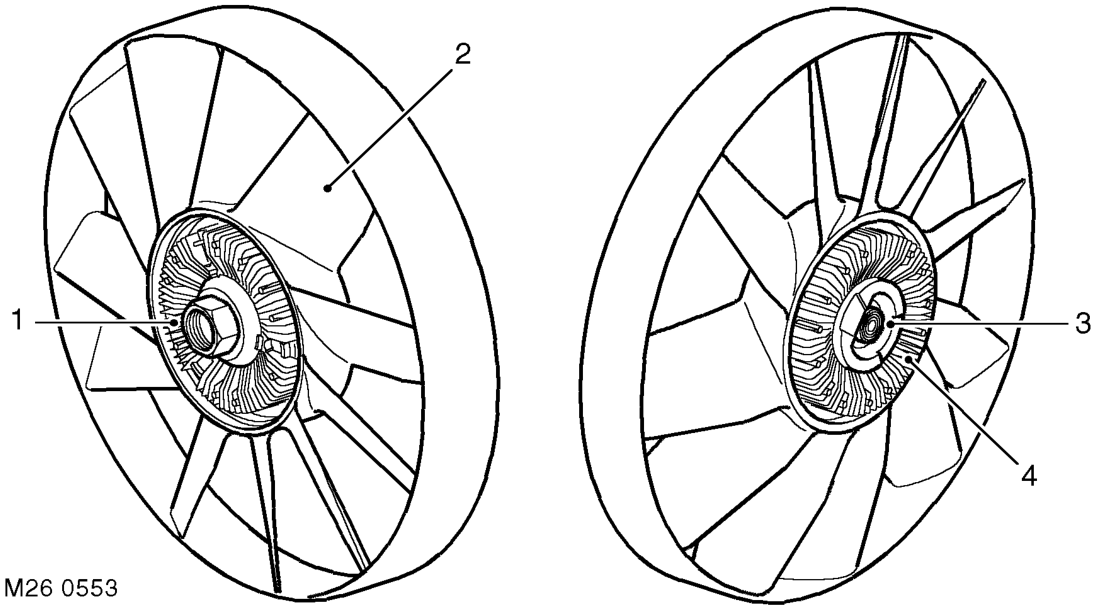
1 Coolant pump pulley drive attachment 2 Fan blades 3 Bi-metallic coil 4 Body
The viscous fan provides a means of controlling the speed of the fan relative to the operating temperature of the engine. The fan rotation draws air through the radiator, reducing engine coolant temperatures when the vehicle is stationary or moving slowly.
The viscous fan is attached to the coolant pump drive pulley and secured to the pulley by a nut. The nut is positively attached to a spindle which is supported on bearings in the fan body. The viscous drive comprises a circular drive plate attached to the spindle and driven from the coolant pump pulley and the coupling body. The drive plate and the body have interlocking annular grooves with a small clearance which provides the drive when silicone fluid enters the fluid chamber. A bi-metallic coil is fitted externally on the forward face of the body. The coil is connected to and operates a valve in the body. The valve operates on a valve plate with ports that connect the reservoir to the fluid chamber. The valve plate also has return ports which, when the valve is closed, scoop fluid from the fluid chamber and push it into the reservoir under centrifugal force.
Silicone fluid is retained in a reservoir at the front of the body. When the engine is off and the fan is stationary, the silicone fluid level stabilises between the reservoir and the fluid chamber. This will result in the fan operating when the engine is started, but the drive will be removed quickly after the fan starts rotating and the fan will 'freewheel'.
At low radiator temperatures, the fan operation is not required and the bi-metallic coil keeps the valve closed, separating the silicone fluid from the drive plate. This allows the fan to 'freewheel' reducing the load on the engine, improving fuel consumption and reducing noise generated by the rotation of the fan.
When the radiator temperature increases, the bi-metallic coil reacts and moves the valve, allowing the silicone fluid to flow into the fluid chamber. The resistance to shear of the silicone fluid creates drag on the drive plate and provides drive to the body and the fan blades.
Parts & tools for this job For Land Rover Discovery
- FLUIDCoolantSearch: Land Rover coolant antifreeze
- PARTThermostatSearch: Land Rover Discovery thermostat
- TOOLCooling system pressure testerSearch: cooling system pressure tester
Links open Amazon search results in a new tab. As an Amazon Associate I earn from qualifying purchases.