
Crankshaft Position (CKP) Sensor
- Make
- Land Rover
- Model
- Freelander System Description and Operation (UK)
- Section
- Description and operation › Crankshaft Position (CKP) Sensor
Crankshaft Position (CKP) Sensor
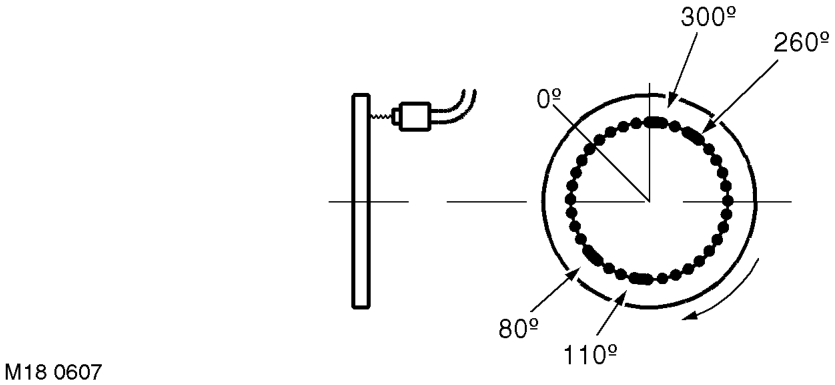
The variable reluctance CKP sensor is mounted at the rear of the engine with the sensor tip facing the engine side of the flywheel and is secured in the casting with a single screw. The sensor tip of the CKP sensor is adjacent to a profiled target ring formed on the inner face of the flywheel.
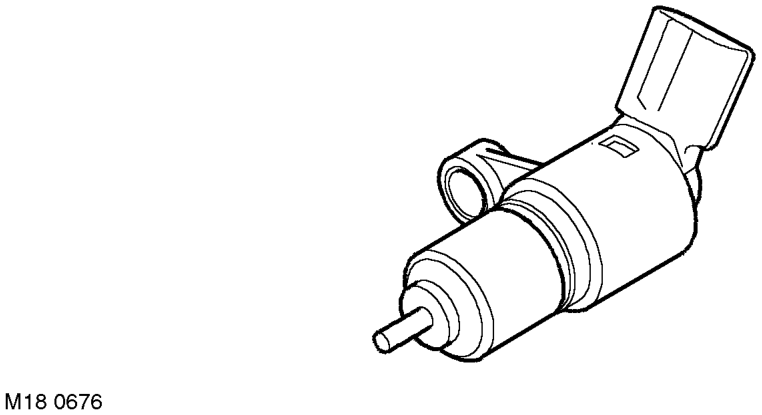
The signal produced by the CKP sensor allows the ECM to calculate the rotational speed and angular position of the crankshaft. This information is required by the ECM to calculate ignition timing, fuel injection timing and fuel quantity during all conditions when the engine is cranking or running. If the CKP sensor signal is missing, the vehicle will not run as there is no substitute signal or default value.
The CKP sensor is a variable reluctance sensor and provides an analogue voltage output to pins 4 and 30 of ECM connector C0914, relative to the speed and position of the target on the flywheel. A permanent magnet inside the sensor applies a magnetic flux to a sensing coil winding. This creates an output voltage which is read by the ECM.
As the gaps between the poles of the target pass the sensor tip, the magnetic flux is interrupted and this causes a change to the output voltage (e.m.f.).
It is important to note that the ECM is unable to determine the exact position of the engine with its four stroke cycle from the CKP sensor alone, the CMP sensor must also be referenced to provide sufficient data for ignition control and sequential injection.
Parts & tools for this job For Land Rover Freelander
- TOOLOBD2 scannerSearch: OBD2 scanner
- TOOLDigital multimeterSearch: automotive digital multimeter
- TOOLBack-probe test leadsSearch: back probe test leads
Links open Amazon search results in a new tab. As an Amazon Associate I earn from qualifying purchases.