
Throttle Position (TP) Sensor
- Make
- Land Rover
- Model
- Freelander System Description and Operation (UK)
- Section
- Description and operation › Throttle Position (TP) Sensor
Throttle Position (TP) Sensor
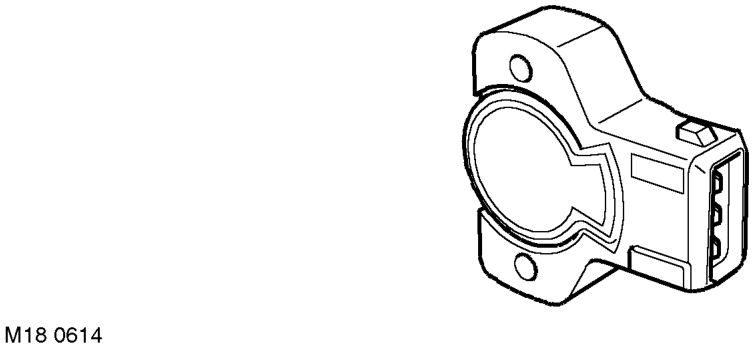
The TP sensor is mounted on the throttle body and is driven from the end of the throttle spindle. The TP sensor consists of a potentiometer which provides an analogue voltage that the ECM converts to throttle position information.
The TP sensor signal is required for the following vehicle functions: l Idle speed control. l Throttle damping. l Deceleration fuel cut off. l Engine load calculations. l Acceleration enrichment. l Full load enrichment. l Automatic gearbox shift points.
The TP sensor is a potentiometer which acts as a voltage divider in an external ECM circuit. The potentiometer consists of a 4kΩ ±20% resistive track and a wiper arm, driven by the throttle spindle, which sweeps over the track.
The track receives a regulated 5 V ±4% supply from pin 46 of ECM connector C0914, together with an earth path from pin 34 of ECM connector C0914. As the wiper arm moves over the track it will connect to areas of different voltage ranging from 0 to 5 volts. The 'output' from the wiper arm is connected to pin 20 of ECM connector C0914, to provide an analogue voltage signal.
The TP sensor requires no adjustment as the ECM will learn the lower voltage limit which corresponds to closed throttle.
If the TP sensor signal is missing the vehicle will continue to run but may suffer from poor idle control and throttle response. The ECM will store fault codes which can be retrieved using TestBook.
Parts & tools for this job For Land Rover Freelander
- TOOLOBD2 scannerSearch: OBD2 scanner
- TOOLDigital multimeterSearch: automotive digital multimeter
- TOOLBack-probe test leadsSearch: back probe test leads
Links open Amazon search results in a new tab. As an Amazon Associate I earn from qualifying purchases.