
Idle Air Control Valve (IACV)
- Make
- Land Rover
- Model
- Freelander System Description and Operation (UK)
- Section
- Description and operation › Idle Air Control Valve (IACV)
Idle Air Control Valve (IACV)
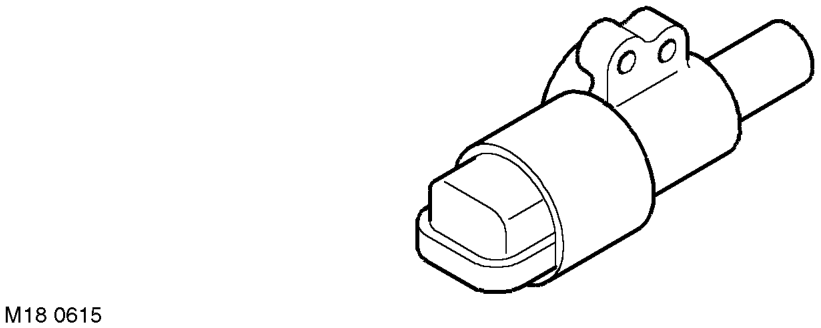
The IACV is located on the inlet manifold. It allows the ECM to control the engine idling speed by regulating the amount of air which by-passes the throttle valve. It also allows the ECM to provide a damping function when the throttle is closed under deceleration which reduces hydrocarbon (HC) emissions.
The IACV is controlled by the ECM using a stepper motor. This consists of a core which is rotated by magnetic fields produced by two electro-magnet bobbins set at 90° to each other.
The stepper motor controls the volume of air passing through a duct which leads from the inlet manifold to a pipe connected to the throttle body. The bobbins are connected to the ECM driver circuits.
Each of the four connections can be connected to 12 volts or earth, enabling four 'phases' to be obtained. The ECM drives the four phases, known as 'A', 'B', 'C' and 'D', from pins 39, 13, 50 and 24 respectively of ECM connector C0914, to obtain the desired idle speed.
When the ignition is switched off the ECM enters a power down routine which includes 'referencing' the stepper motor. This means that the ECM will rotate the motor so that it can memorise the position when it next needs to start the engine.
The stepper motor referencing procedure can take from three to five seconds. If the ECM cannot reference the stepper motor during power down, it will do so at ignition on. If the stepper motor fails, there are no back up idle control systems. The idle speed may be too high or too low and if a load is placed on the engine it may stall. The ECM will store fault codes which can be retrieved by TestBook.
Ignition Coils
Two ignition coils are mounted on the camshaft cover above the spark plugs for cylinders 1 and 3 and secured with screws.
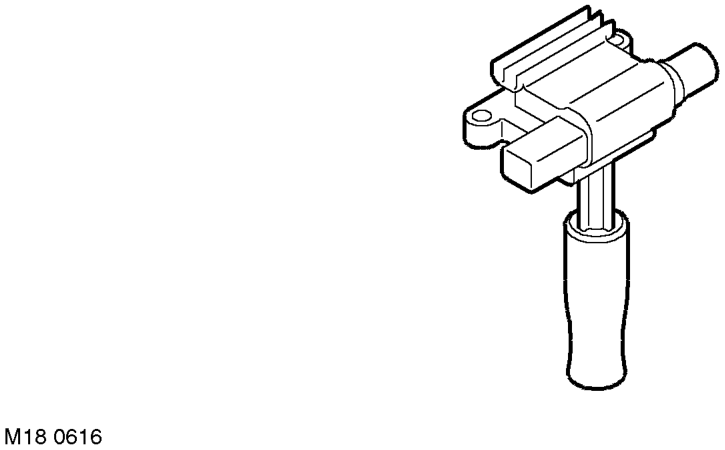
Each coil operates a pair of spark plugs using the wasted spark principle. The coil has a plug connection on its lower face and an HT lead which connects to the second plug.
Parts & tools for this job For Land Rover Freelander
- PARTEngine gasket setSearch: Land Rover Freelander engine gasket set
- TOOLTorque wrenchSearch: 3/8 inch torque wrench
- TOOLFeeler gauge setSearch: feeler gauge set
Links open Amazon search results in a new tab. As an Amazon Associate I earn from qualifying purchases.