
Checking winding resistance (page 2 of 2)
- Make
- Fiat
- Model
- Bravo /Brava (182) Factory Service Manual
- Year
- 1995–2001
- Section
- Fuel system (98 range, 1581 16v)
This is the sensor which measures the oxygen content in the exhaust gases.
The sensor's output signal is sent to the electronic control unit to adjust the air-petrol mixture, in order to maintain the mixture's stoichiometric ratio as close as possible to the theoretical value.
To obtain an optimum mixture, the quantity of fuel injected must be as close as possible to the theoretical quantity which would be required to be fully burnt in relation to the quantity of air drawn in by the engine.
In this case the Lambda (λ) factor is 1; in fact:
λ= QUANTITY OF AIR DRAWN IN ÷ QUANTITY OF THEORETICAL AIR REQUIRED TO BURN ALL THE INJECTED FUEL
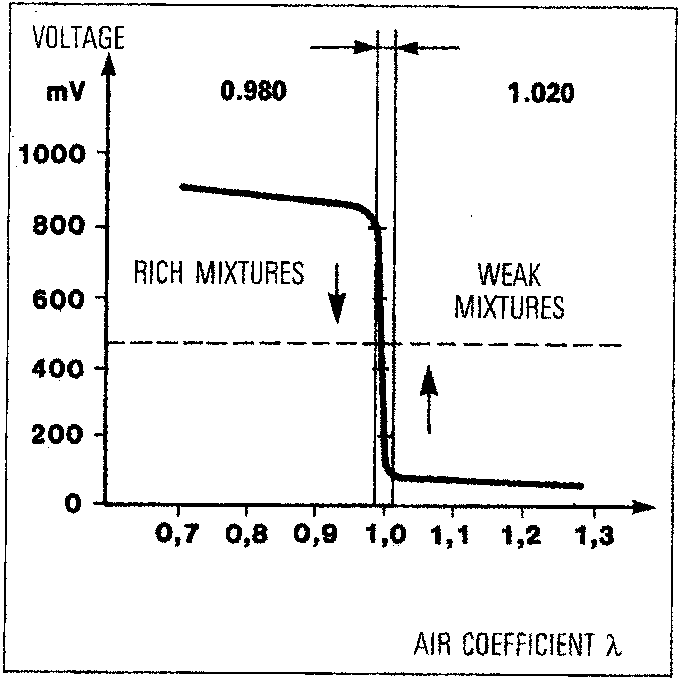
λ= 1 Ideal mixture
The CO is within legal limits
λ ≫ 1 Weak mixture
Excess air; the CO tends to be low
λ ≦ 1 Rich mixture
Lack of air; the CO tends to be high
NOTE While the coefficient λ expresses the excess or shortfall of air supplied to the engine in relation to the value theoretically required, the air-petrol mixture is a ratio between these two substances which, combined together, react chemically. For today's engines, this means that they require 14.7-14.8 parts of air to burn 1 part petrol.
The probe is mounted upstream of the catalytic converter.
This consists of a ceramic casing (1) based on zirconium dioxide, covered with a thin layer of platinum closed at one end, inserted in a protective pipe (2) and housed in a metal casing (3), which provides further protection and permits assembly onto the exhaust manifold. The outer part (B) of the ceramic is exposed to the exhaust gas current, while the inner part (A) communicates with the ambient air.
The operation of the probe is based on the fact that at temperatures exceeding 300°C, the ceramic material becomes a conductor of oxygen ions. Under these conditions, if the quantitiy of oxygen on the two sides (A and B) of the probe is in different percentages, a voltage variation between the two ends is generated, which is an indicator of the difference in quantity of oxygen in the two environments (air side and exhaust gas side).
Parts & tools for this job For 1995 Fiat Bravo
- PARTFuel filterSearch: Fiat Bravo 1995 fuel filter
- TOOLFuel pressure test kitSearch: fuel pressure test kit
- TOOLFuel line disconnect toolSearch: fuel line disconnect tool
Links open Amazon search results in a new tab. As an Amazon Associate I earn from qualifying purchases.