
Evaporative emission control components (Emission control - V8) (page 5 of 9)
- Make
- Land Rover
- Model
- Discovery II (UK)
- Section
- Description and operation
Canister Vent Solenoid (CVS) unit – (NAS with vacuum type, fuel evaporation leak detection system only)
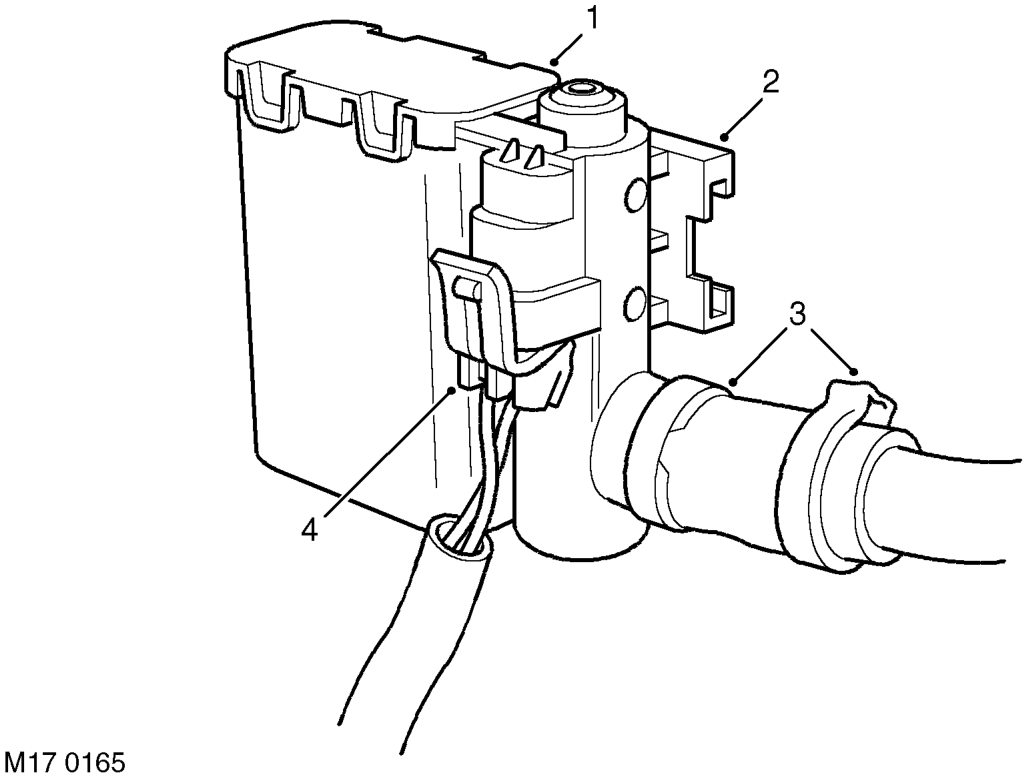
1 CVS unit 2 Mounting bracket 3 Spring clips to pipe from EVAP canister 4 Harness connector
The canister vent solenoid (CVS) valve is mounted on a slide-on bracket which is riveted to the cruise control bracket at the right hand side of the engine compartment. The vent pipe from the EVAP canister is connected to a stub pipe on the CVS unit via a hose and plastic pipe combination. A two-pin connector links to the engine management ECM via the engine harness for solenoid control; one of the wires is the supply feed from fuse No.2 in the engine compartment fusebox, the other wire is the valve drive line to the ECM. The solenoid is operated when the ECM grounds the circuit.
The valve is normally open, allowing any build up of air pressure within the evaporation system to escape, whilst retaining the environmentally harmful hydrocarbons in the EVAP canister. When the ECM is required to run a fuel system test, the CVS valve is closed to seal the system. The ECM is then able to measure the pressure in the fuel evaporative system using the fuel tank pressure sensor.
The ECM performs electrical integrity checks on the CVS valve to determine wiring or power supply faults. The ECM can also detect a valve blockage if the signal from the fuel tank pressure sensor indicates a depressurising fuel tank while the CVS valve should be open to atmosphere.
Parts & tools for this job For Land Rover Discovery
- PARTExhaust gasketSearch: Land Rover Discovery exhaust gasket
- TOOLPenetrating oilSearch: penetrating oil
- TOOLOBD2 scannerSearch: OBD2 scanner
Links open Amazon search results in a new tab. As an Amazon Associate I earn from qualifying purchases.