
Exhaust emission control components (Emission control - V8)
- Make
- Land Rover
- Model
- Discovery II (UK)
- Section
- Description and operation › Exhaust emission control components
Changes in the oxygen content has subsequent effects on the levels of exhaust emissions experienced. The levels of hydrocarbons and carbon monoxide produced around the stoichiometric ideal control range are minimised, but peak emission of oxides of nitrogen are experienced around the same range.
Fuel metering For a satisfactory combustion process, precise fuel injection quantity, timing and dispersion must be ensured. If the air:fuel mixture in the combustion chamber is not thoroughly atomized and dispersed during the combustion stroke, some of the fuel may remain unburnt which will lead to high HC emissions.
Ignition timing The ignition timing can be changed to minimise exhaust emissions and fuel consumption in response to changes due to the excess air factor. As the excess air factor increases, the optimum ignition angle is advanced to compensate for delays in flame propagation.
Exhaust emission control components
The exhaust emission control components are described below:
Catalytic converter
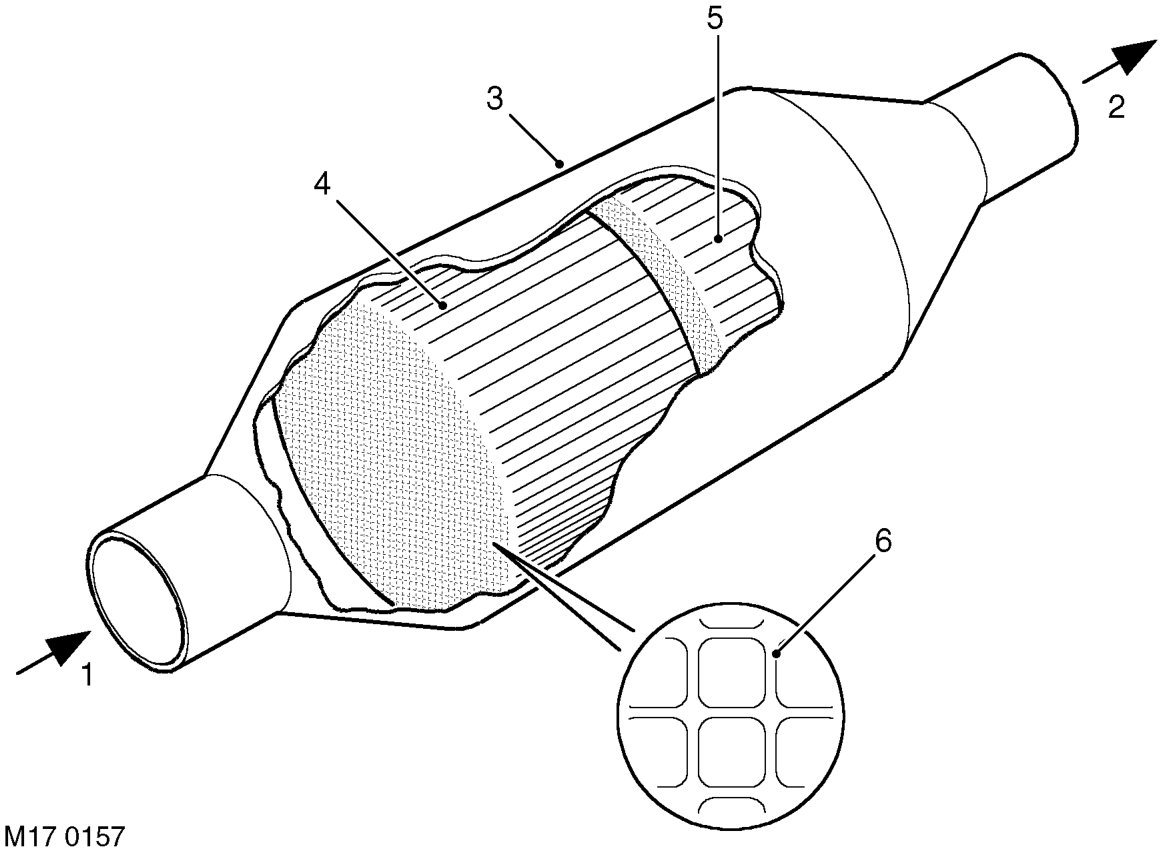
1 Exhaust gas from manifold 2 Cleaned exhaust gas to tail pipe 3 Catalytic converter outer case
4 1st ceramic brick 5 2nd ceramic brick 6 Honeycomb structure
The catalytic converters are located in each of the front pipes from the exhaust manifolds.
Parts & tools for this job For Land Rover Discovery
- PARTExhaust gasketSearch: Land Rover Discovery exhaust gasket
- TOOLPenetrating oilSearch: penetrating oil
- TOOLOBD2 scannerSearch: OBD2 scanner
Links open Amazon search results in a new tab. As an Amazon Associate I earn from qualifying purchases.