
Engine - Td5 (Description): Description and operation (page 2 of 7)
- Make
- Land Rover
- Model
- Discovery II (UK)
- Section
- Description and operation
Two plastic dowels are used to locate the cylinder head to the cylinder block and must be replaced every time the cylinder head is removed from the cylinder block.
Connecting rods
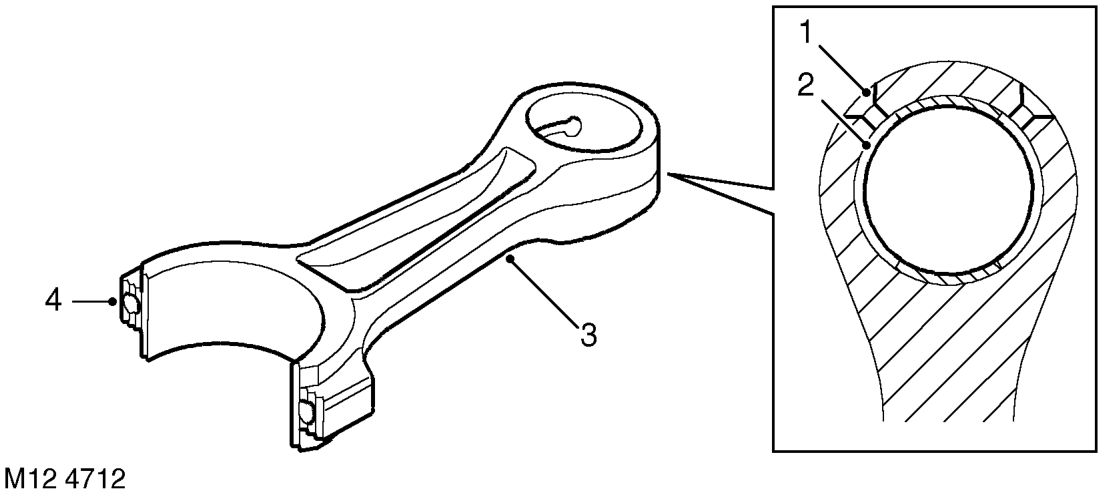
1 Small-end oil holes 2 Small-end bushing 3 Connecting rod 4 Serrated fracture
The connecting rods are machined, H-sectioned steel forgings which feature a fracture-split at the big-end between the connecting rod and the bearing cap. The connecting rod features a serrated fracture across the big-end at right angles to the length of the connecting rod, this forms a unique mating surface between the connecting rod and the fractured end which is used as the big-end cap. The use of a fracture-split in the big-end of the connecting rod ensures a perfect match for assembly on the crankshaft bearing journals and provides the connecting rod with strong resistance to lateral movement.
The end-cap fixing bolts are offset to ensure that the cap is fitted to the connecting rod in the correct orientation. If the end-cap is fitted incorrectly and the end-cap bolts tightened, the connecting rod must be replaced, since the matching serrations will have been damaged.
The big-end bearing shells are plain split halves without location tags. On EU2 models the two halves of the bearing shells are of different construction. The upper half bearing shell fitted to the connecting rod is treated using the sputtering process. The connecting rod bearing shell can be identified by having a slightly darker colouration than the end cap bearing shell and the back of the connecting rod bearing shell has a shinier finish than the front face.
On EU3 models both bearing shells are of the same construction as the connecting rod bearing shell.
The small-end of the connecting rod has a bushed solid eye which is free to move on the gudgeon pin, the bushing is a hand-push interference fit. The steel bushing has two slots machined in its upper surface for providing oil lubrication to the moving surface with the gudgeon pin. The oil slots must be correctly aligned to the oil slots provided in the small end of the connecting rod. The small-end lubrication is supplied by squirt feed from the piston lubrication jets.
Parts & tools for this job For Land Rover Discovery
- PARTEngine gasket setSearch: Land Rover Discovery engine gasket set
- TOOLTorque wrenchSearch: 3/8 inch torque wrench
- TOOLFeeler gauge setSearch: feeler gauge set
Links open Amazon search results in a new tab. As an Amazon Associate I earn from qualifying purchases.