
Engine - Td5 (Description): Description and operation (page 5 of 7)
- Make
- Land Rover
- Model
- Discovery II (UK)
- Section
- Description and operation
Oil filters The Td5 engine features two types of oil filter; the main filter is a standard disposable cartridge-type full-flow oil filter which is augmented with a by-pass centrifuge filter used to filter out particulate matter having a diameter smaller than 15 micron but greater than 3 micron.
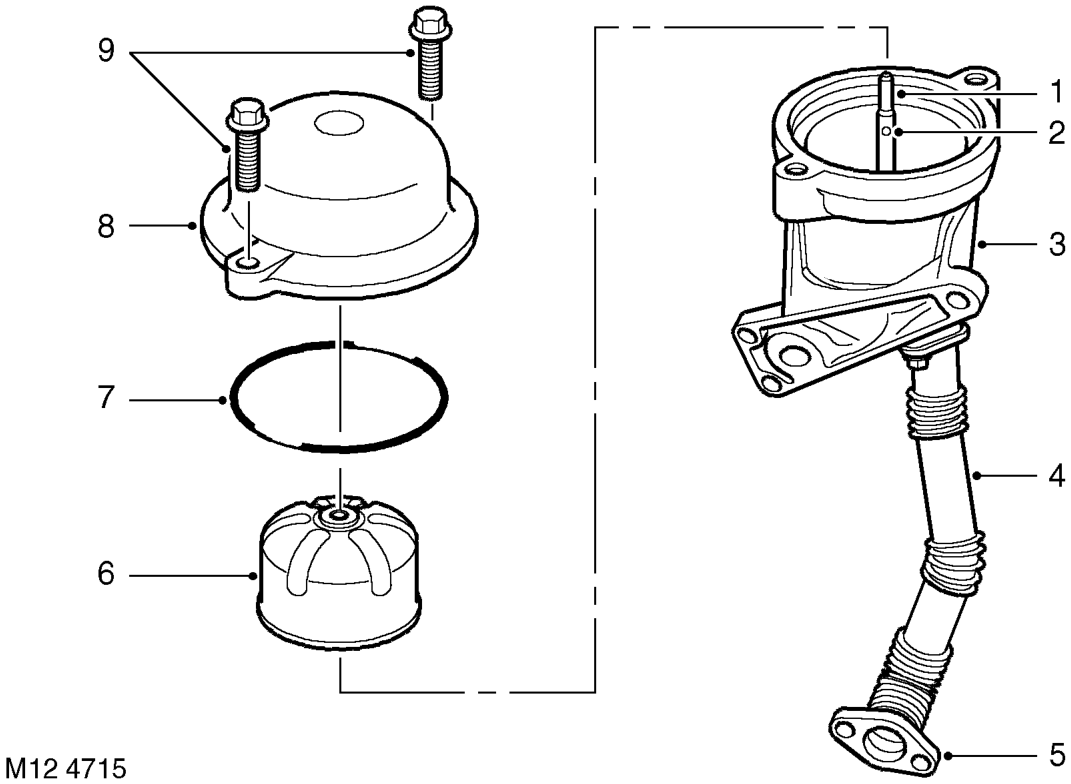
1 Centre spindle 2 Spindle oil holes (2 off) 3 Centrifuge filter housing 4 Centrifuge filter drain pipe 5 Port – centrifuge filter drain pipe to sump
6 Filter rotor 7 Internal seal 8 Cover 9 Cover bolts (2 off)
The centrifuge filter is located on the left hand side of the engine block by the exhaust manifold and is housed in a pot which is bolted to the oil cooler housing by means of three bolts. The pot contains a rotor located on a central spindle which spins at up to 15,000 revs/min. when oil is flowing through the unit under pressure. The rotor contains two fine holes drilled at obtuse angles which cause the rotor to spin about the centre spindle when high pressure oil is passing through it. The inner surface of the rotor captures carbon deposits and small particulate matter as it is thrown outwards under centrifugal force to form a sludge on the inner walls of the rotor. The unit is able to trap very fine impurities that build up in the oil that would be too small to filter using the normal paper-element type full-flow filters alone.
Approximately 10% of the total oil flow enters the centrifuge pot through a side port in the pot casting which is mated to an outlet port at the lower side of the oil cooler housing. A rubber O-ring sits in a recess around the oil cooler port which seals the faces between the centrifuge pot and oil cooler port, and it must be replaced every time the centrifuge assembly is removed. Oil leaves the centrifuge pot through a drain tube which is attached to the base of the pot by means of two fixing screws. The lower end of the drain tube returns oil to the sump and is fixed to the sump by means of two screws. Gaskets are included at the port interfaces between the oil drain tube and the centrifuge pot, and the oil drain tube and sump return port; these gaskets must be replaced every time the oil drain tube is removed.
The centrifuge cover is fixed to the pot by two screws and is sealed by an 'O'-ring.
Parts & tools for this job For Land Rover Discovery
- PARTEngine gasket setSearch: Land Rover Discovery engine gasket set
- TOOLTorque wrenchSearch: 3/8 inch torque wrench
- TOOLFeeler gauge setSearch: feeler gauge set
Links open Amazon search results in a new tab. As an Amazon Associate I earn from qualifying purchases.