Connecting rods
- Make
- Rover
- Model
- 600 Rover 600 Repair Manual - Volumes 1 and 2 - 2nd Edition
- Section
- Cylinder block: repairs › Connecting rods
CONNECTING RODS
Selection
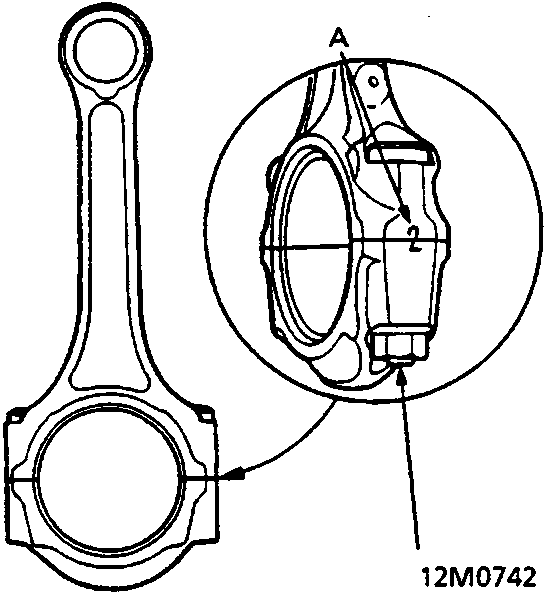
A Connecting Rod Bore Reference Number or Bar
Each rod falls into one of four tolerance ranges (from 0 to 0.024 mm in 0.006 mm increments) depending on the size of its big end bore. It is then stamped with a number or bar (1, 2, 3, or 4/l, il, iil, or iiil) indicating the range with half the number or bar on the bearing cap and the other half on the connecting rod.
You may find any combination of 1, 2, 3, or 4/l, il, iil, or iiil in any engine.
The normal bore size is 48.0 mm.
Note:
- Reference numbers or bars are for big end bore size and do not indicate the position of the rod in the engine.
- Inspect connecting rod for cracks and heat damage.
- Inspect bolts and nuts for stress cracks.
PISTON RINGS
End Gap
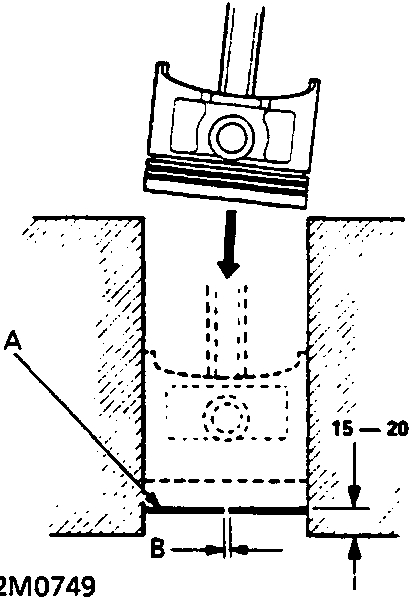
A Piston Ring
B End Gap
- Using a piston, push a new ring into the cylinder bore 15 – 20 mm from the bottom.
- Measure the piston ring end – gap with a feeler gauge.
- If the gap is too small, check to see if you have the correct rings for your engine.
- If the gap is too large, recheck the cylinder bore diameter against the wear limits. If the bore is over the service limit, the cylinder block must be rebored.
Piston Ring End – Gap:
Top Ring
Standard (New): 0.20 – 0.35 mm
Service Limit: 0.60 mm
Second Ring
Standard (New): 0.40 – 0.55 mm
Service Limit: 0.70 mm
Oil Ring
Standard (New): 0.20 – 0.70 mm
Service Limit: 0.80 mm
Oversize:
0.25: 85.25 mm
0.50: 85.50 mm
Parts & tools for this job For Rover 600
- PARTEngine gasket setSearch: Rover 600 engine gasket set
- TOOLTorque wrenchSearch: 3/8 inch torque wrench
- TOOLFeeler gauge setSearch: feeler gauge set
Links open Amazon search results in a new tab. As an Amazon Associate I earn from qualifying purchases.