
Climate Control Diagnostics
- Make
- Aston Martin
- Model
- DB7 Factory Workshop Manual Volume 2: Electrics, Body and Air Conditioning
- Year
- 1994–1998
- Section
- Operating instructions › Climate Control Diagnostics
Climate Control Diagnostics
The air conditioning control module is located at the right end of the air conditioning unit. Since this controller uses a unique communications protocol, the PDU must be connected directly to the unit via the Vehicle Interface Adaptor as shown in the following cable setup screen.
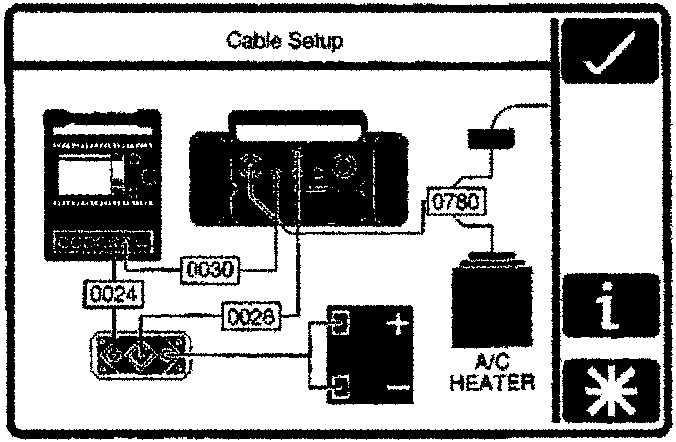
A digital microprocessor within the control module receives data signals from the operator controlled switches. Comparison of these signals with those returned from system temperature sensors and feedback devices results in the appropriate output voltage changes needed to vary: Blower motor speed, flap position and the solenoids which respond to operator selected temperature demand.
The air from two blower motors is passed through the evaporator matrix which, depending on the positions of the humidity buttons, removes heat from the incoming air. Depending on the position of the two blend flaps, the cold air either passes directly to the vehicle outlet vents, or is passed through the heater matrix to be reheated and then to the vehicle outlet vents.
The amount of air passing through the heater matrix is infinitely variable depending on ambient temperature and the temperature selected within the vehicle.
Selecting ‘Climate Control’ from the vehicle area menu, will present the technician with the datalogger tool selection screen.
Details of the signals which may be monitored in the system may be found in the DB7 Workshop Manual - Section 8 - Air Conditioning'
Anti-Lock Braking Diagnostics
The Teves Mk IV Braking System consists of two subsystems, power braking and anti-lock braking.
The PDU software (DataLogger) only allows the monitoring of the anti-lock braking system.
The ABS System consists of:
- Four wheel speed sensors.
- One control module.
- Seven solenoid valves.
- One pressure switch.
- One fluid level switch.
The ABS System is controlled and continuously monitored by the ABS control module, which automatically switches off the system if a failure is identified, illuminating a warning lamp and leaving full, boosted braking to all wheels. A wheel speed sensor is installed at each wheel. Their wheel speed related signals are processed by the control module, which triggers the solenoid valves to modulate hydraulic pressure, preventing the wheels from locking. The control module also monitors the fluid level and will inhibit ABS operation should low fluid level be detected.
The DataLogger function will permit monitoring of the complete system apart from the solenoid valves. The control module transmits short duration test pulses of 25 to 100 microseconds to the solenoid valves. These pulses are too fast for the PDU to monitor and as a result would cause confusing waveforms.
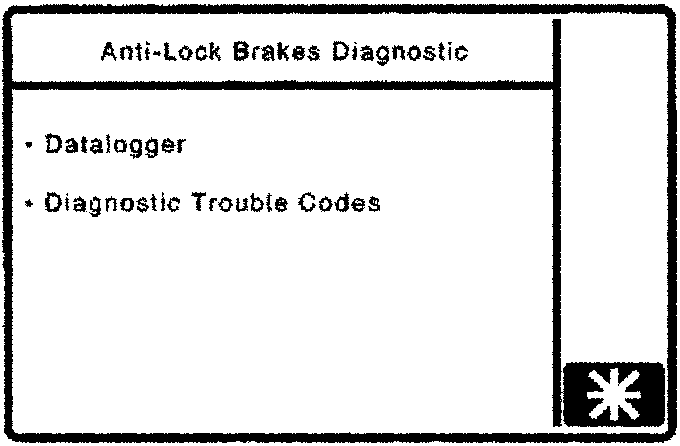
Selecting 'Anti-Lock Braking' from the vehicle area menu, will present the technician with the following menu of diagnostic tools screen:
ABS Diagnostic Trouble Codes
The DTCs which are supported in the Teves Mk IV ABS system are listed in the workshop manual - Section 5 Brakes Wheels and Tyres.
Parts & tools for this job For 1994 Aston Martin DB7
- TOOLOBD2 scannerSearch: OBD2 scanner
- TOOLDigital multimeterSearch: automotive digital multimeter
- TOOLBack-probe test leadsSearch: back probe test leads
Links open Amazon search results in a new tab. As an Amazon Associate I earn from qualifying purchases.