
Gearshift Timing
- Make
- Aston Martin
- Model
- DB7 Factory Workshop Manual Volume 2: Electrics, Body and Air Conditioning
- Year
- 1994–1998
- Section
- Operating instructions › Gearshift Timing
Automatic transmission DB7s are fitted with a GM4L80-E gearbox electronically controlled by a Transmission Control Unit (TCM)
The TCM is mounted on the rear left wheel arch. It may be electronically accessed from the upper diagnostic socket.
The TCM continuously monitors requests made by the driver via the gear selector, throttle pedal, mode switch, etc. This data is used in conjunction with speed input from the transmission unit to calculate the optimum shift points under current conditions. Shift pressure and ignition retard are also controlled from this data to enhance shift quality and reduce transmission wear.
The TCM also detects faults within the transmission system and stores the relevant fault codes for later analysis.
gearshifts are controlled by two solenoid valves and a pressure regulator within the transmission valve block assembly.
If a serious fault occurs, the TCM removes all electrical power from these valves and the transmission defaults to a 'limp home' condition. In this state, only mechanical selection of either reverse or second gear is available.
Gearshift Timing
Inputs from the performance mode switch (Sport, Normal or 1st Gear Inhibit) and the throttle position sensor are used to modify transmission gearshift operation as required by the driver.
Sport mode raises the roadspeed at which gearshifts occur enabling higher acceleration rates for the vehicle.
1st gear inhibit prevents engagement of first gear to reduce the risk of wheel slip in icy conditions.
The throttle position sensor signal is continuously monitored by the TCM to detect a rapid throttle opening. If the throttle position sensor signal rises rapidly to above 4.5 volts, a 'Kickdown' condition is initiated. In this condition, upshifts are delayed to higher road speeds to provide the higher acceleration required for overtaking etc.
TCM - PCM Communication
The interface between TCM and PCM allows continuous exchange of the primary data required to appropriately control the gearshifts required during driving under a wide range of conditions.
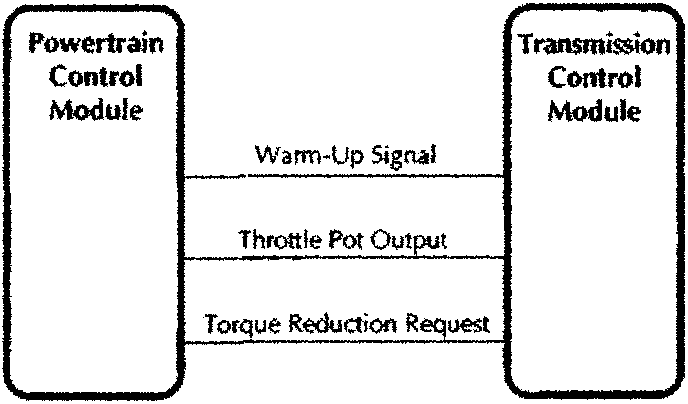
Warm-Up
The Warm-Up signal is sent from the TCM to the PCM and is used to detect when the transmission reaches normal operating temperature of approximately 100°C (212°F). As this temperature is reached, the modified gearshift timing required with a cold gearbox may be abandoned in favour of the standard timing for a warm gearbox.
Throttle Pot Output
The ThrottlePot Output signal is sent from the PCM to the TCM. The TCM can then use this information to control shift timing in relation to the power demanded by the driver.
Torque Reduction Request
The Torque Reduction Request signal is sent from the TCM to the PCM. It is used to temporarily retard the ignition timing during gear shifts to improve shift quality. When the gearshift is completed, ignition timing will be returned to normal.
Parts & tools for this job For 1994 Aston Martin DB7
- TOOLOBD2 scannerSearch: OBD2 scanner
- TOOLDigital multimeterSearch: automotive digital multimeter
- TOOLBack-probe test leadsSearch: back probe test leads
Links open Amazon search results in a new tab. As an Amazon Associate I earn from qualifying purchases.