
Engine management system - Td5 (Clutch switch): Description and operation
- Make
- Land Rover
- Model
- Discovery II (UK)
- Section
- Description and operation › Clutch switch
Clutch switch
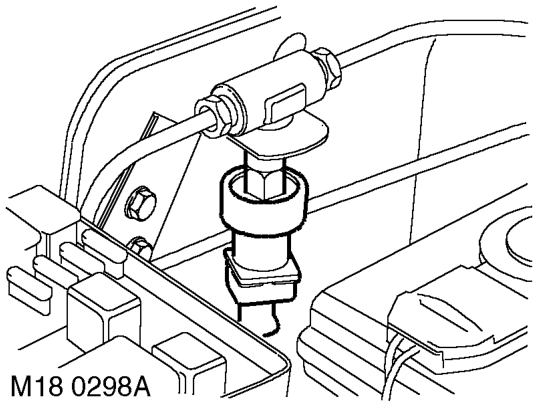
The clutch switch is located at the rear of the engine compartment on the RH side. The switch is operated by hydraulic pressure when the clutch pedal is pressed. The ECM uses the signal from the clutch switch for the following functions: l To cancel cruise control if operating. l To provide surge damping during gear change.
Surge damping stops engine speed rising dramatically (engine flaring) during gear change. Surge damping assists driveability as follows: l Smoother gear change. l Greater exhaust gas emission control. l Improved fuel consumption.
Input/Output The clutch switch receives battery voltage from the BCU. With the clutch pedal in the rest position the switch is closed, allowing battery voltage to pin 35 of the ECM connector C0658. When the clutch pedal is pressed the switch contacts open, interrupting the power supply to the ECM. The ECM receives 0 Volts.
The clutch switch can fail in the following ways: l Switch open circuit. l Short circuit to vehicle supply. l Short circuit to earth.
In the event of a clutch switch failure the ECM will react as follows: l Surge damping will be inactive. l Cruise control will be inactive.
High/Low ratio switch
Refer to transfer box for description of the high/low ratio switch. TRANSFER BOX - LT230SE, DESCRIPTION AND OPERATION, Description.
Parts & tools for this job For Land Rover Discovery
- TOOLOBD2 scannerSearch: OBD2 scanner
- TOOLDigital multimeterSearch: automotive digital multimeter
- TOOLBack-probe test leadsSearch: back probe test leads
Links open Amazon search results in a new tab. As an Amazon Associate I earn from qualifying purchases.