
Electronic Unit Injector (EUI) (Engine management system - Td5)
- Make
- Land Rover
- Model
- Discovery II (UK)
- Section
- Description and operation › Electronic Unit Injector (EUI)
Electronic Unit Injector (EUI)
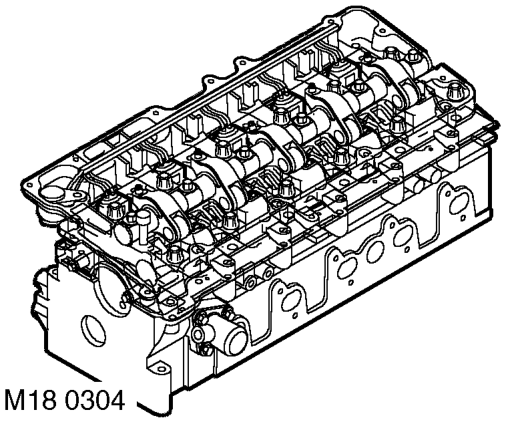
The EUI's are located in the top of the engine inside the camshaft cover. There is one EUI per cylinder. They inject finely atomised fuel directly into the combustion chamber. Each EUI has its own electrical connection, which is linked to a common harness also located under the camshaft cover. Each of the EUI has its own 5 letter grading code. This code is used so that greater EUI precision is achieved.
The ECM provides the earth path for the EUI. Using an injection-timing map within its memory and information from the crankshaft speed and position sensor the ECM is able to determine precise crankshaft angle. When the ECM determines the crankshaft speed and position it closes the spill valve within the EUI. Fuel pressure rises inside the EUI to a predetermined limit of, 1500 bar (22,000 lbf.in2) on pre EU3 models, and 1750 bar (25,500 lbf.in2) on EU3 models, at this limit the pintle lifts off its seat allowing the fuel to inject into the combustion chamber. The ECM deenergises the spill valve to control the quantity of fuel delivered. This causes a rapid pressure drop within the EUI which allows the EUI return spring to re-seat the pintle ending fuel delivery.
The electrical circuit that drives the EUI works in two stages depending on battery voltage. If battery voltage is between 9 and 16 volts the EUI's will provide normal engine performance. If however battery voltage falls to between 6 and 9 volts, on pre EU3 models, EUI operation is restricted to a limit of 2100 rev/min, on EU3 models EUI operation is restricted to idle.
If the vehicle is fitted with a new ECM, the EUI grades for that specific vehicle must be downloaded to the new ECM using TestBook. In the event of the engine failing to rev above 3000 rev/min it is probable that the EUI grading has not been completed.
Input/Output Input to the EUI takes the form of both mechanical and electrical signals. The mechanical input to the EUI is diesel fuel via the fuel pump operating at approximately 4 to 5 bar (58 to 72 lbf.in2). Each of the EUI's is operated mechanically by an overhead camshaft to enable injection pressures of up to 1500 bar (22,000 lbf.in2) on pre EU3 models, and 1750 bar (25,500 lbf.in2) on EU3 models, to be achieved. The ECM controls the EUI's to ensure that fuel delivery is precise and as intended.
Parts & tools for this job For Land Rover Discovery
- PARTFuel filterSearch: Land Rover Discovery fuel filter
- TOOLFuel pressure test kitSearch: fuel pressure test kit
- TOOLFuel line disconnect toolSearch: fuel line disconnect tool
Links open Amazon search results in a new tab. As an Amazon Associate I earn from qualifying purchases.