
Engine management system - Td5 (Turbocharger): Description and operation
- Make
- Land Rover
- Model
- Discovery II (UK)
- Section
- Description and operation › Turbocharger
Turbocharger
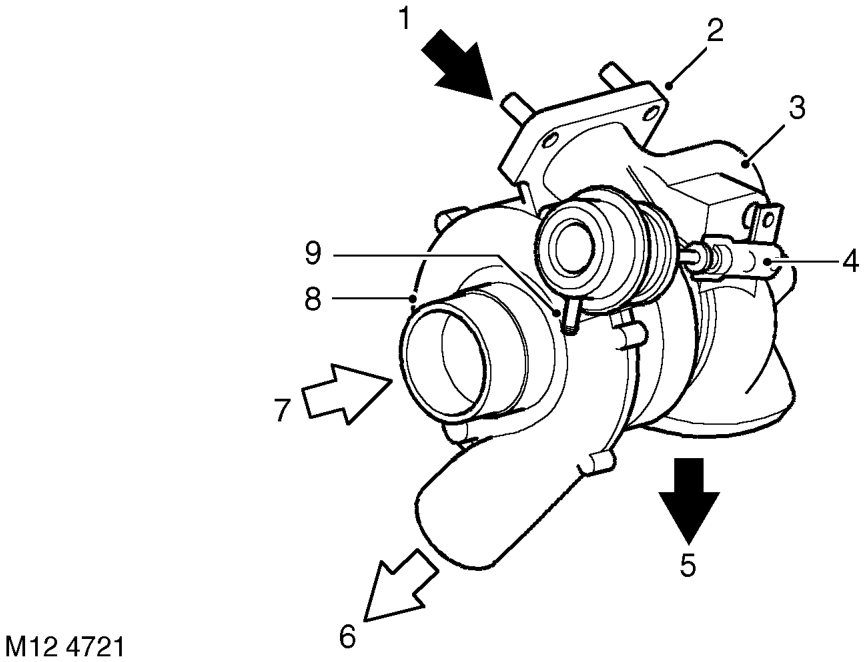
1 Exhaust gas from manifold 2 Studs to exhaust manifold 3 Turbocharger cast iron housing 4 Wastegate valve linkage 5 Exhaust gas out to front exhaust pipe 6 Compressed intake air 7 Fresh intake air 8 Turbocharger aluminium alloy housing 9 Wastegate valve vacuum port
The Td5 engine utilises a Garrett GT20 turbocharger with an electronically controlled wastegate modulator to improve engine performance. The turbocharger uses the engine's exhaust gas to spin a turbine at very high speed. This causes inlet air on the other side of the turbine to be drawn in through the turbocharger intake for compression. The inlet air is carried round by the vanes of the compressor and then thrown out under centrifugal force from the turbocharger's outlet duct. This compression of air enables a greater quantity of air to be delivered to the inlet manifold via an intercooler. Combustion is improved through better volumetric efficiency. The use of a turbocharger improves fuel consumption and increases engine torque and power. Exhaust noise is also reduced due to the smoothing out of exhaust pulsations.
The rear cast iron body of the turbocharger housing connects to a port on the exhaust manifold at the LH side of the cylinder head by three studs and nuts. The interface between the exhaust manifold and the turbocharger housing is separated by a metal gasket. The exhaust outlet of the turbocharger is located at the bottom of the turbocharger cast iron housing; it is connected to the exhaust system front downpipe and is attached by three studs and nuts. The interface between the turbocharger housing and the exhaust front pipe is separated by a metal gasket.
The front casing of the turbocharger is constructed from aluminium alloy and is connected to the air inlet duct by a metal band clip. The compressed air outlet is connected to the intercooler by a metal pipe which has rubber hose extensions at each end attached by metal band clips.
Parts & tools for this job For Land Rover Discovery
- PARTEngine gasket setSearch: Land Rover Discovery engine gasket set
- TOOLTorque wrenchSearch: 3/8 inch torque wrench
- TOOLFeeler gauge setSearch: feeler gauge set
Links open Amazon search results in a new tab. As an Amazon Associate I earn from qualifying purchases.