
Turbocharger wastegate modulator (Engine management system - Td5)
- Make
- Land Rover
- Model
- Discovery II (UK)
- Section
- Description and operation › Turbocharger wastegate modulator
Turbocharger wastegate modulator
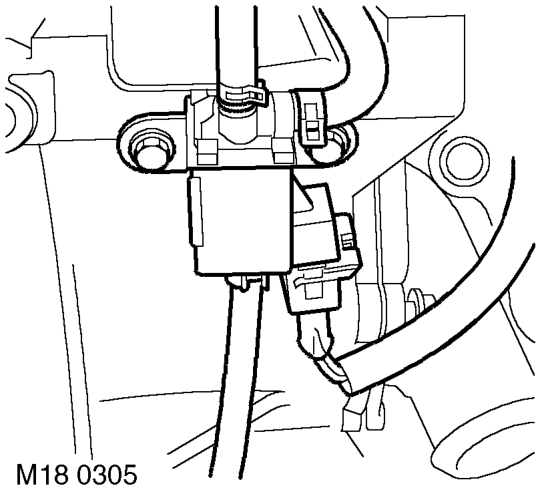
The turbocharger wastegate modulator is located on the ancillary bracket on the engine, and is connected by flexible pipes to the turbocharger. The modulator controls turbocharger boost pressure by varying the pressure used to open the turbocharger wastegate. This control is vital to ensure the turbocharger does not over boost the engine.
Input/Output The turbocharger wastegate modulator receives battery voltage from the main relay. The ECM supplies the earth path in the form of a pulse width modulated (PWM) signal. The PWM signal from the ECM operates the modulator at a frequency of less than 50 Hz. This signal allows the turbocharger wastegate modulator to open and close the wastegate. This permits a proportion of the exhaust gas to bypass the turbocharger through the wastegate, thereby regulating boost pressure.
Input voltage to the turbocharger wastegate modulator is via the main relay.
The earth path is via a PWM signal generated at pin 21 of the ECM connector C0158.
The turbocharger wastegate modulator can fail as follows: l Open circuit. l Short circuit to voltage supply. l Short circuit to vehicle earth. l Wiring loom fault. l Connector water ingress. l Connector failure due to excess heat. l Component failure due to excess heat. l Component failure due to excess vibration.
In the event of a turbocharger wastegate modulator failure any of the following symptoms may be observed: l Reduced engine performance. l Increased engine performance. l Lack of power. l Excess smoke. l Reduced fuel economy.
The MIL will not illuminate in the event of a turbocharger wastegate modulator failure.
Parts & tools for this job For Land Rover Discovery
- PARTEngine gasket setSearch: Land Rover Discovery engine gasket set
- TOOLTorque wrenchSearch: 3/8 inch torque wrench
- TOOLFeeler gauge setSearch: feeler gauge set
Links open Amazon search results in a new tab. As an Amazon Associate I earn from qualifying purchases.