
ACE Electronic control unit (ECU) (Front suspension)
- Make
- Land Rover
- Model
- Discovery II (UK)
- Section
- Description and operation › ACE Electronic control unit (ECU)
ACE Electronic control unit (ECU)
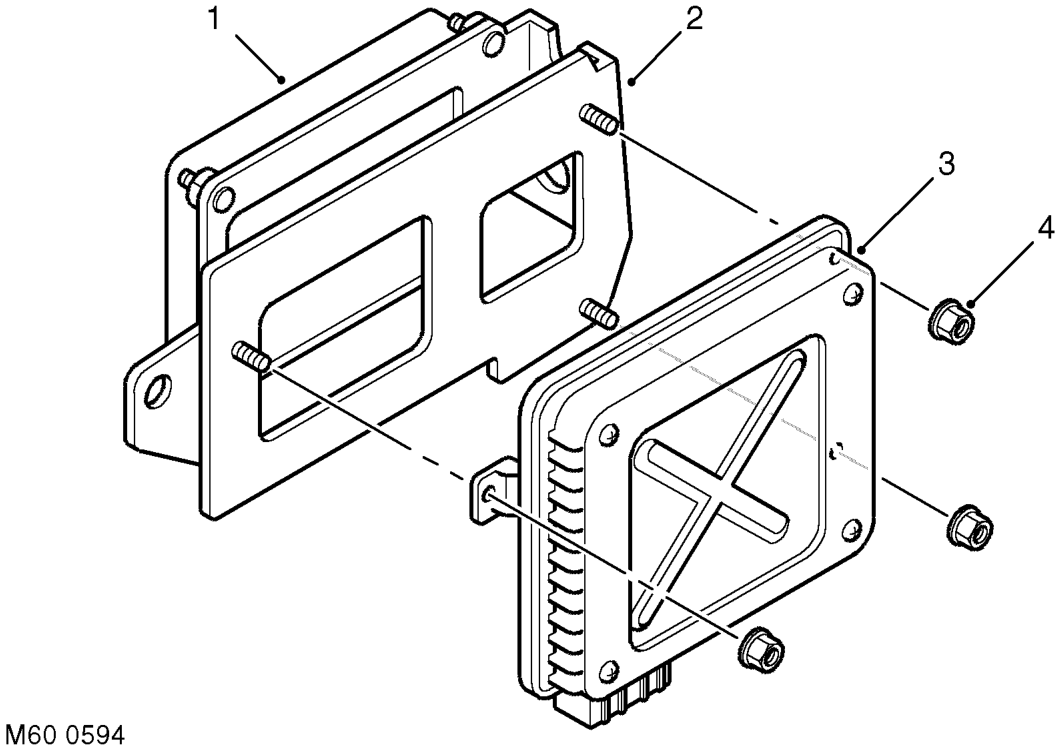
1 Body Control Unit (Ref. only) 2 Bracket 3 ACE Electronic control unit 4 Attachment nuts 3 off
The ACE ECU is mounted on a bracket behind the passenger glove box and is identified from the other ECU's by its single electrical harness connector. The single 36 pin connector is located on the lower face of the ECU and mates with a connector from the main harness. The connector supplies power, ground, signal and sensor information to/from the ECU for control of the ACE system.
The ACE ECU receives a battery power supply from fuse 15 in the engine compartment fusebox via the ACE relay, also located in the engine compartment fusebox. The ECU provides an earth path for the relay coil, energising the coil and supplying power to the ECU.
An ignition on signal is supplied from the ignition switch via fuse 29 in the passenger compartment fusebox. The ignition on signal provides an input to the ECU which tells the ECU that ignition has been selected on and initiates a 250 ms start time. The start time is used to prevent functions operating when software routines are being initialised.
The ignition on signal, when removed, tells the ECU that the ignition is off. The ECU will remain powered for thirty seconds after the ignition is turned off. The thirty second period allows the ECU to store values and fault flags in the memory. These values are read by the ECU when the next ignition on signal is received.
An engine speed signal is transmitted to the ECU from the Engine Control Module (ECM) as a pulsed digital signal. The engine speed signal is used by the ACE ECU to detect that the engine is running and hydraulic pressure for ACE system operation is available.
Parts & tools for this job For Land Rover Discovery
- TOOLCoil spring compressorSearch: coil spring compressor
- TOOLBall joint separatorSearch: ball joint separator
- PARTFront shock absorbersSearch: Land Rover Discovery front shock absorbers
Links open Amazon search results in a new tab. As an Amazon Associate I earn from qualifying purchases.