
Front suspension (ACE system): Description and operation
- Make
- Land Rover
- Model
- Discovery II (UK)
- Section
- Description and operation › ACE system
ACE system
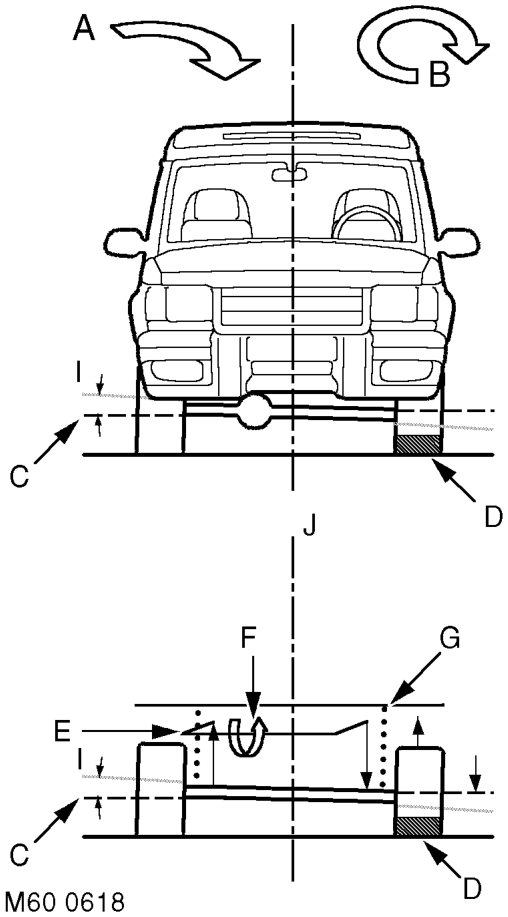
a Direction of travel - Right hand bend b Body roll c Axle roll d Tyre squash e Torsion/Anti-roll bar f Direction of torsion/anti-roll bar twist g Coil springs h Body roll angle i Axle roll angle j Reduced body roll angle with ACE system
The system is electrically and hydraulically operated with all operations controlled by an ACE ECU located behind the glovebox in the passenger side footwell. The ACE system comprises front and rear torsion bars and actuators, two accelerometers, ECU, hydraulic pump, valve block and a fluid reservoir.
The ACE system gives improved vehicle handling and suspension characteristics and is active for both on and offroad driving. This is achieved by hydraulic actuators applying torque to the front and rear torsion bars in response to lateral forces sensed by accelerometers. The ACE system prevents body roll with cornering forces of up to 0.4 g. From 0.4 g there is a progressive increase in body roll but significantly lower than a passive system. A passive system will have a progressive increase in roll angle as soon as cornering forces are applied and will have a higher roll angle than the ACE system for the same cornering force.
The ACE system can also detect if the vehicle is driven off-road. If off-road conditions are detected the ACE system operation will be reduced or completely disabled at a speed of 25 mph (40 km/h) or less.
Parts & tools for this job For Land Rover Discovery
- TOOLCoil spring compressorSearch: coil spring compressor
- TOOLBall joint separatorSearch: ball joint separator
- PARTFront shock absorbersSearch: Land Rover Discovery front shock absorbers
Links open Amazon search results in a new tab. As an Amazon Associate I earn from qualifying purchases.