
Front suspension (Hydraulic pump): Description and operation
- Make
- Land Rover
- Model
- Discovery II (UK)
- Section
- Description and operation › Hydraulic pump
Hydraulic pump
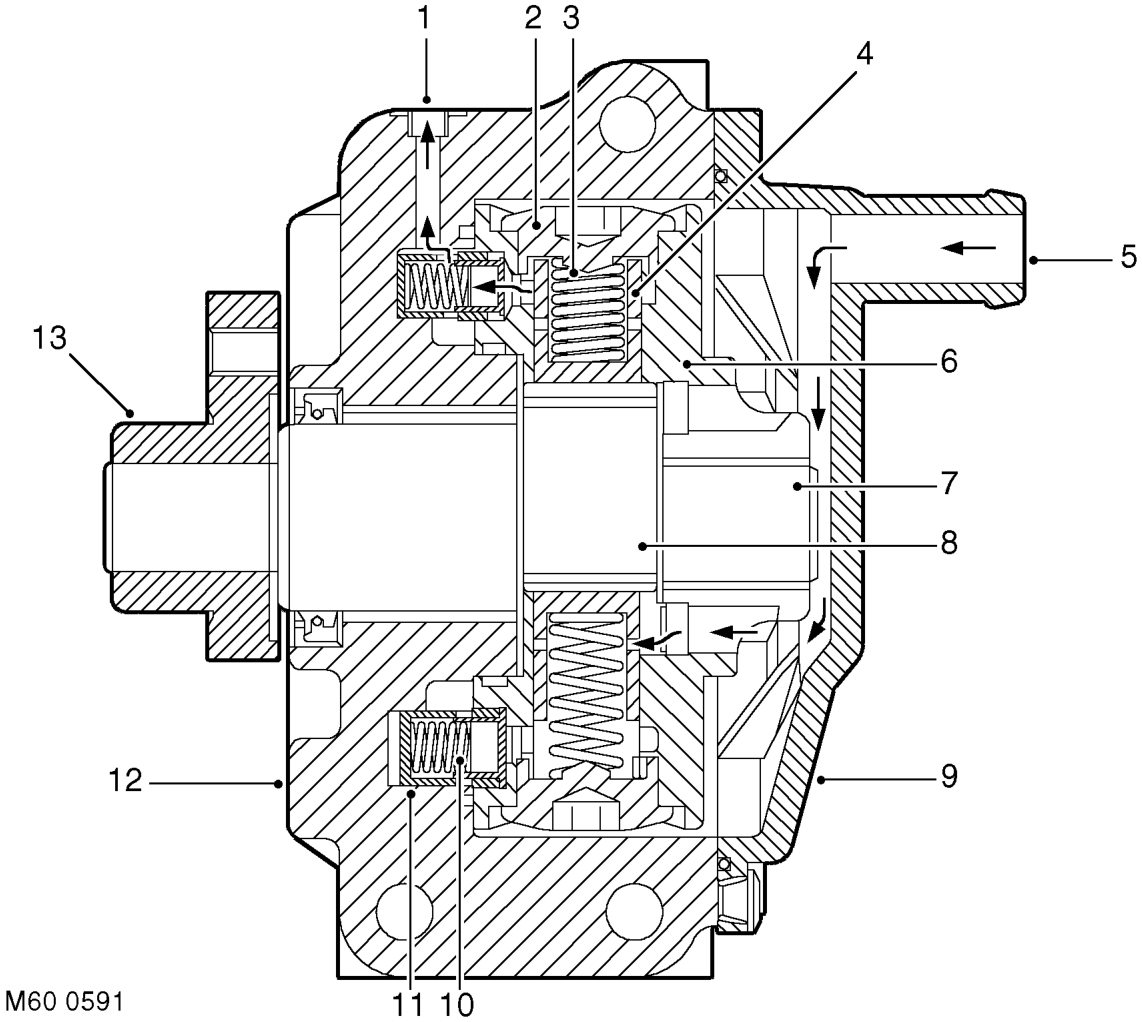
1 Outlet port 2 Cap 3 Piston spring 4 Piston 5 Inlet port 6 Cylinder housing 7 Shaft
8 Cam 9 Inlet housing 10 Spring 11 Discharge valve 12 Housing 13 Pulley attachment flange
The hydraulic pump is attached to a bracket on the left hand side of the engine and is driven at crankshaft speed by the auxiliary drive belt. The pump is of the radial piston type which delivers fluid at high pressure.
The radial piston pump has six pistons located in bores in a cylinder housing. A central shaft, which is driven by a pulley and the auxiliary drive belt, has a cam which operates the pistons as it rotates.
As the cam lobe reaches each piston, the piston is pushed outward, moving the fluid above the piston. The pressure created by the fluid flow from the bore opens a spring loaded discharge valve and allows the fluid to flow to the pump outlet port. When the piston reaches its full stroke, the flow reduces and the discharge valve closes under spring pressure.
Parts & tools for this job For Land Rover Discovery
- TOOLCoil spring compressorSearch: coil spring compressor
- TOOLBall joint separatorSearch: ball joint separator
- PARTFront shock absorbersSearch: Land Rover Discovery front shock absorbers
Links open Amazon search results in a new tab. As an Amazon Associate I earn from qualifying purchases.