
Engine management system - V8 (Ignition coils): Description and operation
- Make
- Land Rover
- Model
- Discovery II (UK)
- Section
- Description and operation › Ignition coils
Ignition coils
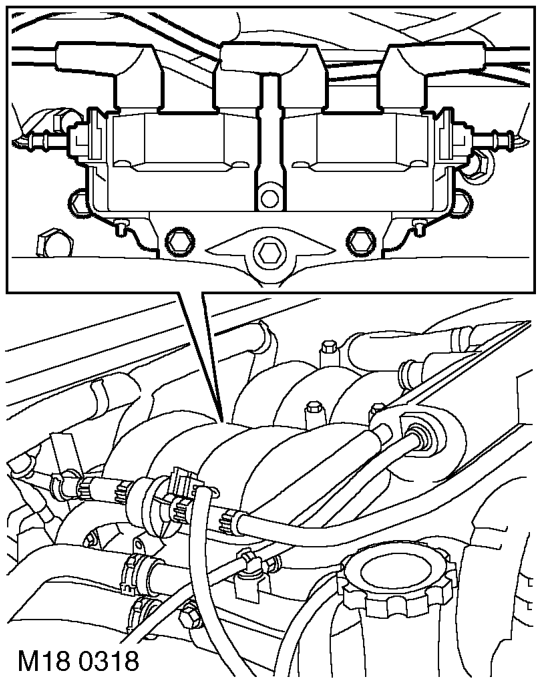
Two double ended ignition coils are located at the rear of the engine, below the inlet plenum camber mounted on a bracket. The ignition system operates on the wasted spark principle. When the ECM triggers an ignition coil to spark, current from the coil travels to one spark plug jumping the gap at the spark plug electrodes igniting the mixture in the cylinder. Current continues to travel along the earth path (via the cylinder head) to the spark plug negative electrode at the cylinder that is on the exhaust stroke. The current jumps across the spark plug electrodes and back to the coil completing the circuit. Since it has sparked simultaneously in a cylinder that is on the exhaust stroke it has not done any work, therefore it is wasted.
The coils are paired in the following cylinder order: l 1 and 6. l 8 and 5. l 4 and 7. l 3 and 2.
The ECM calculates the dwell timing from battery voltage, and engine speed to ensure constant secondary energy. This ensures sufficient spark energy is always available without excessive primary current flow and thus avoiding overheating or damage to the coils. Individual cylinder spark timing is calculated from the following signals: l Engine speed. l Engine load. l Engine temperature. l Knock control. l Automatic gearbox shift control. l Idle speed control.
During engine warm up ignition timing should be an expected value of 12° BTDC.
TestBook can not directly carry out diagnostics on the high-tension side of the ignition system. Ignition related faults are monitored indirectly by the misfire detection system.
Input/Output Input to the low tension side of the ignition coils comes from Fuse 14 located in the passenger compartment fuse box. This fuse provides battery power for two ignition coils.
Parts & tools for this job For Land Rover Discovery
- PARTSpark plugsSearch: Land Rover Discovery spark plugs
- TOOLSpark plug socketSearch: spark plug socket
- TOOLSpark plug gap toolSearch: spark plug gap tool
Links open Amazon search results in a new tab. As an Amazon Associate I earn from qualifying purchases.