
Ignition module
- Make
- Alfa Romeo
- Model
- 145/146 Electrical System Diagnosis Manual, Volume 3
- Year
- 1994–2001
- Section
- Electrical components › Ignition module
IGNITION MODULE
(1596 c.c. Rochester)
The ignition system is of the static, lost spark type, managed together with injection by the Rochester control unit. Static ignition no longer includes the distributor to distribute high voltage to the spark plugs; there are two coils integrated in a single unit with the corresponding power modules.
Each secondary winding of the coils is connected to the two spark plugs of the cylinders which, kynematically, move together (1-2 e 3-4).
The more important advantages are:
- higher power of the spark
- greater reliability
- reduction of radio disturbances
- smaller dimensions.
The control unit detects the angular position and speed of the crankshaft through the rpm and timing sensor.
Additionally, by processing the signals concerning the engine temperature and load, it calculates the spark advance governing the power module of the coil concerned.
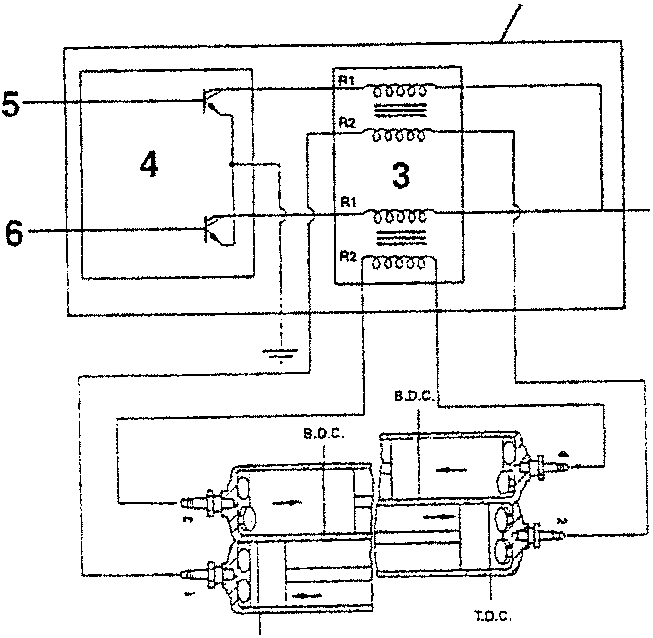
- Ignition module
- Supply (+)
- Coil unit
- Power module
- Command 1-2
- Command 3-4
When the control unit removes the command from the power module, energy is transferred from the primary winding to the secondary.
This transfer instantaneously determines the presence of an induced voltage at the ends of the secondary winding, which will always have the same polarity (one end will have a positive potential and the other a negative potential).
These potentials will therefore also be taken by the central electrodes of the spark plugs connected to them (1-2 or 3-4).
Since the voltage induced on the secondary winding always has the same polarity, the discharge current of the coil on the two spark plugs concerned will always flow in the same direction, thus the sparks will strike in an opposed manner to one another: on the spark plug with the central electrode, with positive voltage, the spark strikes from the earth electrode towards the central electrode, whereas on the spark plug with central electrode, with negative voltage, the spark strikes from the central electrode towards the earth electrode.
The result of this, is that after a few thousand kilometers, analysing the spark plugs, the level of wear of the electrodes may differ: on one, the central electrode with a higher level of wear and on the other, more wear on the earth electrode (this is normal).
The intensity of the sparks is determined by the working conditions of the spark plugs themselves.
In fact, in the cylinder at the T.D.C. at the end of the exhaust stroke, the spark will be very weak (lost spark) due to the presence of uncompressed exhaust gas (lower dielectric), while in the cylinder at the B.D.C. at the end of the compression stroke, there will be an intense spark (useful spark), due to the presence of the compressed air-fuel mixture (higher dielectric).
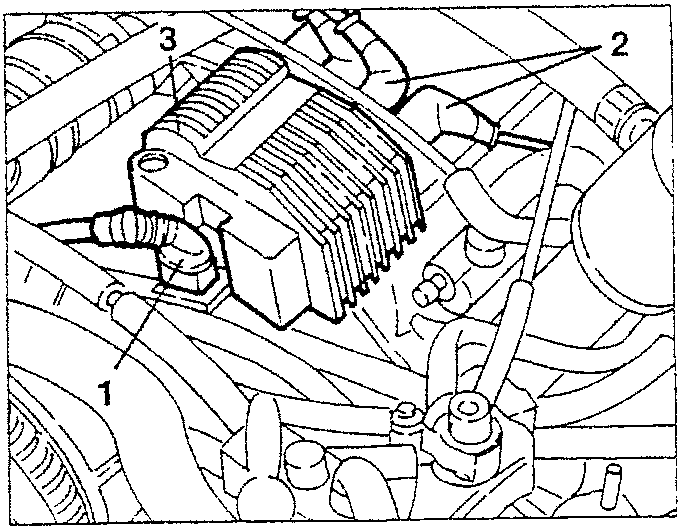
REMOVAL/REFITTING
- Disconnect the battery terminal (-).
- Remove the air intake box (see GROUP 10).
- Disconnect the electrical connection from the ignition coil.
- Disconnect the spark plugs from the ignition coil.
- Slacken the three fastening screws and remove the ignition coil.
Parts & tools for this job For 1994 Alfa Romeo 145/146
- TOOLOBD2 scannerSearch: OBD2 scanner
- TOOLDigital multimeterSearch: automotive digital multimeter
- TOOLBack-probe test leadsSearch: back probe test leads
Links open Amazon search results in a new tab. As an Amazon Associate I earn from qualifying purchases.