
Ignition Timing Control
- Make
- Rover
- Model
- 600 Rover 600 Repair Manual - Volumes 1 and 2 - 2nd Edition
- Section
- Repairs › Ignition Timing Control
Ignition Timing Control
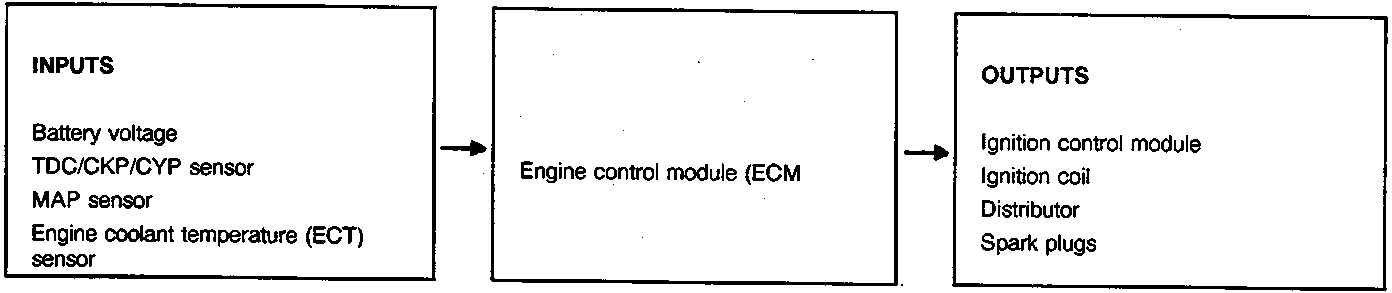
The programmed ignition (PGM – IG) used in this engine provides optimum control of ignition timing. A microcomputer determines the timing in response to engine speed and manifold vacuum. The input signals are transmitted by the TDC/crankshaft position (CKP)/cylinder position (CYP) sensor, throttle position (TP) sensor, engine coolant temperature (ECT) sensor, and MAP sensor. This system, which is not dependent on a governor or vacuum diaphragm, is capable of setting lead angles with complicated characteristics which cannot be provided by conventional governors or diaphragms.
Basic Control
The engine control module (ECM) has stored within it the optimum basic ignition timing for operating conditions based upon engine speed and intake manifold vacuum. With compensating signals from sensors, the system determines optimum ignition timing and duration for ambient conditions and sends voltage pulse to the ICM.
Compensation of ignition timing
| Compensation Item | Related sensor and Information | Description |
|---|---|---|
| Idling | Crank/Cylinder sensor MAP sensor | Ignition timing is controlled to the target speed with compensation according to the idling speed. |
| Compensation at warm – up | ECT Sensor | Lag angle is adjusted according to warm – up conditions to bring about a good balance between operating performance and exhaust emissions. |
| ECT compensation | ECT sensor | Compensation for lead angle at low engine coolant temperature, and lag angle at high engine coolant temperature. |
Control at Start:
Ignition timing is fixed at 7° BTDC for cranking. The cranking is detected by the TDC sensor (cranking rpm) and starter signal.
Parts & tools for this job For Rover 600
- TOOLDigital multimeterSearch: automotive digital multimeter
- PARTAssorted fuse kitSearch: car fuse assortment kit
- TOOLWire crimper and connector kitSearch: wire crimper connector kit
Links open Amazon search results in a new tab. As an Amazon Associate I earn from qualifying purchases.