Starter Replacement
- Make
- Rover
- Model
- 600 Rover 600 Repair Manual - Volumes 1 and 2 - 2nd Edition
- Section
- Repairs › Starter Replacement
ElectricalStarter Replacement · page 1 of 5
- If the starter still does not crank the engine, remove the starter and diagnose its internal problems.
- If the starter cranks the engine, check for:
- blown No. 16 (50 A) fuse in the engine compartment fuse/relay box.
- an open in the BLK/WHT wire and the connectors.
- faulty starter cut relay.
- faulty ignition switch.
- faulty A/T gear position switch (neutral position switch).
- 3. Check for wear or damage:
The starter should crank the engine smoothly and steadily.- If the starter engages, but cranks the engine erratically, check the starter, drive gear and flywheel ring gear for damage, and check the drive gear overrunning clutch for binding or slipping when the armature is rotated with the drive gear held.
- 4. Check cranking voltage and current draw:
- Voltage should be no less than 0.8 volts.
- Current should be no more than 350 amperes.
- low battery.
- open circuit in starter armature commutator segments.
- starter armature dragging.
- shorted armature winding.
- excessive drag in engine.
- 5. Check cranking rpm:
Engine speed during cranking should be above 100 rpm.
If speed is too low, check for:- loose battery or starter terminals.
- excessively worn starter brushes.
- open circuit in commutator segments.
- dirty or damaged helical spline or drive gear.
- defective drive gear overrunning clutch.
- 6. Check the starter disengagement:
Turn the ignition switch to "III" and release to "II" position.
The starter drive gear should disengage from the flywheel ring gear.
If the drive gear hangs up on the flywheel ring gear, check for:- solenoid plunger and switch malfunction.
- dirty drive gear assembly or damaged overrunning clutch.
Starter Replacement
- Disconnect the negative cable from the battery.
- Remove the engine wire harness from the harness clip on the starter motor.
A/T:
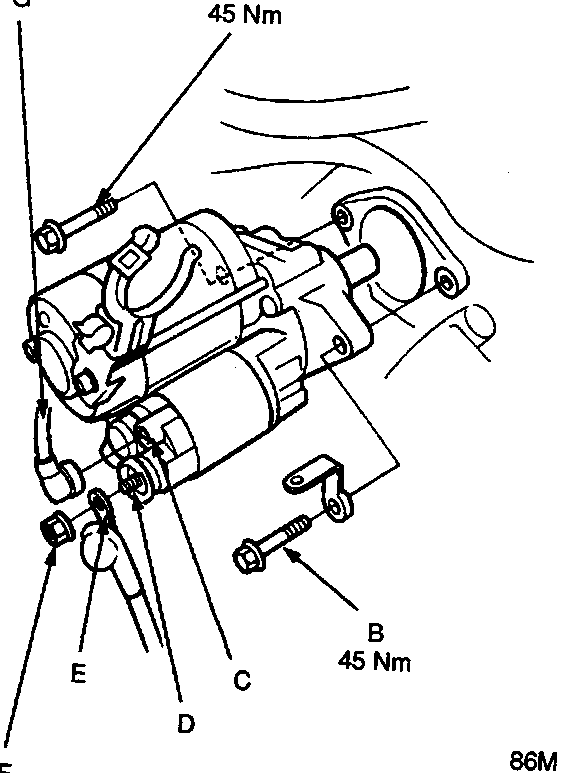
B Mounting bolt
C S terminal
D B terminal
E Starter cable
F Mounting nut
G BLK/WHT wire
Parts & tools for this job For Rover 600
- TOOLBattery testerSearch: car battery tester
- TOOLDigital multimeterSearch: automotive digital multimeter
- TOOLBattery terminal cleanerSearch: battery terminal cleaner
Links open Amazon search results in a new tab. As an Amazon Associate I earn from qualifying purchases.